Witchcraft is an ugly albeit biblical word. I have spent dozens of hours in research, and spilled the equivalent of gallons of ink on this blog to establish the undeniable link between rock music and witchcraft. Having done so it should not then shock us to find this music at the same time also closely associated with rebellion. An old Samuel sadly asserted to his one time protégé, Saul, Rebellion is as the sin of witchcraft. (I Samuel 15.23)
What is rebellion? At its root it is war against God. It is a revolt against His authority and those to whom He dispenses His authority. The devil, of course, was the first rebel. I will ascend into heaven, I will exalt my throne above the stars of God: I will sit also upon the mount of the congregation, in the sides of the north. (Isaiah 14.13) He will not rest until he has fomented rebellion against God in the heart of every human and angelic being he can touch. It is easy to see, then, not perhaps in strict conjunction, but certainly that there is at least a loose association between rebellion and witchcraft.
Rock and roll was birthed in rebellion, the rebellion of the young against their authority. Bill Haley who first topped the charts with a rock song in 1955 did so in the context of a movie soundtrack, MGM's Blackboard Jungle, which purposely attempting to display the "teenage savagery" of a rebellious group of inner city young people. Cliff Richard, in 1961's The Young Ones belted out
Mummy says no
Daddy says no
Brother says no
But they all got to go
'Cause we say yeah
No wonder Marlon Brando, when asked what he was rebelling against, sullenly said, "Whaddya' got?"
That initial rock generation's rebellion was against their parent's morals, the collective cultural habits of decency which they labeled as prudish. So Elvis swung his hips, the teenagers screamed, and suddenly sexuality was no longer repressed but flaunted. As the pop music of the 1950s and early 60s gave way to the British Invasion the rebellion led by the Beatles was not primarily a sexual one; it was the drug-fueled turn on, tune in, drop out of Timothy Leary's countercultural generational stick it to "the man." As the 1960s became the 1970s the rebellion against authority found focus in the student riots and the campus sit-ins of the Vietnam era. By the mid-seventies a new generation of rebellious rockers gave voice to Pink Floyd singing that kids "don't need no thought control" and Johnny Rotten's Anarchy in the UK as they lashed blindly out at everything. And just when we thought rock had run out of things to rebel against came 90s grunge with Nirvana's apathy, nihilism, and fascination with suicide.
The previous paragraph's wide-ranging simplistic recounting of the first fifty years of rock reveals a genre (and numerous sub-genres) that contains over and over again a similar thread – rebellion. Lemmy Kilmister of Motorhead told Spin magazine in 1991, "The essence of rock music is rebellion." Lemmy was right.
I do not deny that rock has become mainstream; in fact, I assert it. But I do deny that rock in so doing has lost its penchant for rebellion. Indeed, I would argue that as rock music has gone mainstream rebellion itself has also gone mainstream. There is now a generally accepted wisdom that teenagers are supposed to rebel against their parents and that young adults are supposed to rebel against their college administrators. It has assumed all the parameters of a youthful rite of passage as if an obedient young person is weirdly wrong. In the 1950s James Dean's Rebel Without a Cause generated an uproar; in contemporary America rebellion has become a main course.
It is interesting to note not only the correlation between witchcraft and rebellion but a similar correlation between the rise of rebellion in American society and the rise of rock music. If you don't believe that I dare you to try to take away the average American teenager's music. Rebellion and rock live in mutually pleasing symbiosis that feeds upon itself. And I do not just mean the lyrics; I mean the music itself.
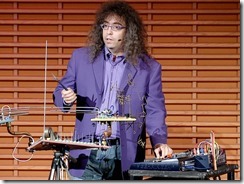 |
| Mark Applebaum |
One of the most popular courses at Stanford University is Associate Professor Mark Applebaum's "Rock, Sex, and Rebellion." The student reviews for it available online are almost exclusively and effusively positive. As an active composer with a PhD in musical composition he not only researches and teaches about music he also writes and performs it. The basic thrust of his course is not a cultural history of rebellious rock stars and their antics although there is certainly enough material for such a course. His premise is that the musical structure itself is rebellious, and that it was birthed from the desire of various sub-cultural groups to make a statement of rebellion. When asked in one interview I read to proffer up a one line description of rock music he offered this: "It's a little glib but I think I can give you a quick 21st century sound-byte response – so I'll invoke Keith Richard's definition: 'Rock 'n' roll is sex and rebellion.' It's not a complete response but if you wanted a super-short version, it would be that."
So, yeah, let's allow this music free reign in the life of our young people. Furthermore, let's embrace this music as a tool for God's church to use in order to reach people more effectively. That makes sense. Witchcraft. Rebellion. Rock. What's not to love?
 In Kimberly Smith's 2005 book, Music and Morals, she states often that the morality of a style of music will be evident in the behavior of those with whom it is closely associated.
This is a critical point for the primary philosophical support for CCM (Christian contemporary music, also sometimes called Christian worship music) is that instrumental music is neither moral nor immoral. Their position is that the music itself has zero to do with a song's morality or immorality. The latter flow exclusively from the words. But is that true?
The dominant form of music in the dominant culture of the world is rock. The dominant aspect of this dominant music is the rhythm, the beat. Assuming we ignore the words for a moment, is there any problem with this rhythm-heavy beat-soaked music? Perhaps the most major proposition of mine in the entirety of this blog series is that there is. I contend that rock music is itself immoral (bad) rather than a-moral (neutral).
For the last ten thousand words or so I have shown you this in painstaking detail via such music's connection to the occult world. I have supported that connection with a mountain of historical, ethnological, anthropological, and musicological facts. Indeed, I find it highly curious that my usual critics have fallen silent. I can only conclude either that they are all on vacation, that they think I've lost my mind and am not worth discussion, or that they have no answers for the facts I have piled up. I will leave you, dear reader, to your own conclusions. Along these same lines, in today's post I want to establish in your minds that this same style of music commonly called rock corrupts sexual morality as well.
I do not mean to impugn the motives of the brethren who disagree with me. They sincerely parrot what they have sincerely swallowed – there is no verse in the Bible that explicitly says instrumental music alone is corrupting. Yet their curious silence regarding one particular passage is so loud as to be downright deafening. Be not deceived: evil communications corrupt good manners. (I Corinthians 15.33) The English word manners is the Greek word ethos. This is its only use in the New Testament and is simply defined as morals or habits. One of my Greek dictionaries defines it as "the inherent complex of habits and attributes that determines a persons moral and ethical actions and reactions."
In twenty-first century America we generally use the word manners to refer to the common politeness that ought to mark the deportment of a gentleman or a lady. "Don't put your elbows on the table. Don't talk with food in your mouth. Mind your manners." But the word has a much deeper meaning than the polite customs of a civilized society. Dictionary.com defines manners as "the prevailing customs, ways of living, and habit of a people." In short, the King James translators chose well when they used the word manners. It is the things that make up a commonly held set of good or bad habits, the morals of a people.
Albert Barnes said about this verse, "The sentiment of the passage is, that the intercourse of evil-minded men, or that the close friendship and conversation of those who hold erroneous opinions, or who are impure in their lives, tends to corrupt the morals, the heart, the sentiments of others." To this Matthew Poole agrees, saying, "though you may judge that they talk but for discourse sake, yet their communication or discourse is naught, and will influence men as to things of practice, and debauch men in their morals." A. T. Robertson in his Word Pictures in the New Testament also agrees. "Old word (kin to ethos) custom, usage, morals. Good morals here."
I am obviously going to great pains to establish this because the importance of it cannot be overstated. The single biggest argument being swallowed today by Christians in relation to their music is that it is neither moral nor immoral. It is neutral until someone adds words. But an understanding of this verse throws that argument out entirely, completely, in every effect. What is music? It is an emotional language. What do languages do? They communicate something. How do we know a particular communication is evil? By looking at what it produces – an evil manner or way of living, corrupted morals.
If I am right that music is an emotional language, and if I am right that there is a basic immorality to the beat-heavy music known as rock then it will be relatively easy to establish, especially since this is the dominant form of music in Western culture. In other words, sexually immoral behavior should be seen widely in those who are heavily involved in rock music.
The absolute fact is I could end this post right here for my point is made. It is so blatantly obvious that the cliché runs, "sex, drugs, and rock and roll." These three things go together like America, mom, and apple pie. It is patently indisputable, and has been observed by every intelligent student of twentieth century music.
For instance, consider the following as a sample:
The West is the only civilization to have created an art form whose sole purpose is to attack morality.
- cultural critic Martha Bayles, Hole in our Soul: The Loss of Beauty and Meaning in American Popular Music
Rock music has one appeal only, a barbaric appeal to sexual desire - not love, not eros, but sexual desire undeveloped and untutored. Rock gives children, on a silver platter, with all the public authority of the entertainment industry, everything their parents always used to tell them they had to wait for until they grew up and would understand later.
- Allan Bloom, The Closing of the American Mind
Listen man, what takes place on the stage of a rock concert doesn't happen spontaneously. It is carefully planned to elicit a sexual response from the audience.
- Terry Knight, manager of Grand Funk Railroad
Pop music revolves around sexuality. I believe that if there is anarchy, let's make it sexual anarchy rather than political.
- Adam Ant
When you're in a certain frame of mind, particularly sexually-oriented, there's nothing better than rock and roll.
- David Krebs, manager of Aerosmith
Rock 'n roll is synonymous with sex and you can't take that away from it. It just doesn't work.
- Steven Tyler of Aerosmith
I'm in rock music for the sex and narcotics.
- Glenn Frey of the Eagles
You can feel the adrenalin flowing through your body. It's sort of sexual. I entice my audience. What I do is very much the same as a girl's strip-tease dance.
- Mick Jagger of the Rolling Stones
I do deliver sex appeal. It's part of modern rock.
- Freddie Mercury of Queen
I feel spiritual up there. Think of us as erotic politicians.
- Jim Morrison of the Doors
Rock 'n roll is 99% sex.
- John Oates of Hall and Oates
Rock music is sex and you have to hit them in the face with it.
- Andrew Oldham, manager of the Rolling Stones
Rock n roll is sexually...you music.
- Jimmy Page of Led Zeppelin
That's what rock is all about - sex with a 100 megaton bomb, the beat.
- Gene Simmons of KISS
Rock music is sex. The big beat matches the body's rhythms.
- Frank Zappa
The historically accurate truth is that Alan Freed, who first popularized the term "rock and roll" almost certainly got it from a 1951 Dominoes rhythm and blues hit, "Sixty Minute Man", which is nothing more than a paean to sex. The Dominoes got it from the popular usage of the term in the juke joints and R and B circuit of the 1940s American South.
Look a here girls I'm telling you now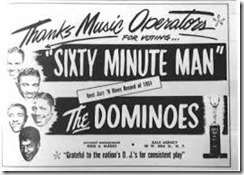
They call me "Lovin' Dan"
I rock 'em, roll 'em all night long
I'm a sixty-minute man
If you don't believe I'm all that I say
Come up and take my hand
When I let you go you'll cry "Oh yes,"
"He's a sixty-minute man"
There'll be 15 minutes of kissing
Then you'll holler "please don't stop"
There'll be 15 minutes of teasing
And 15 minutes of squeezing
And 15 minutes of blowing my top
With this fact rock critic and historian Michael Ventura emphatically agrees in his essay I have already cited in this series, Hear That Long Snake Moan, in such graphic language that I cannot even quote it with specificity here. The paragraph in question ends with, "When, finally, in the mid-fifties, the songs started being played by white people and aired on the radio – "Rock Around the Clock," "Good Rockin' Tonight," "Reelin' And A-Rockin' " – the meaning hadn't changed. The word was so prevalent that the music began to be called "rock 'n roll" by disc jockeys who either didn't know what they were saying or were too sly to admit what they knew. The term stuck."
Apparently, however, the only people who cannot recognize the explicit connection between the rhythms of rock and sexual excess are the Christians of contemporary America. To them, it just makes sense to use rock music to attract and hold people to the modern church. After all, that is what they like.
I agree it makes sense. James does too. In fact, he calls it wise, albeit the worst kind of wisdom. This wisdom descendeth not from above, but is earthly, sensual, devilish.
James was ahead of his time. He just perfectly described rock music 1900 years before it began.
Note: this is, again, a longer post than I am normally comfortable with; it is so because it contains a number of specific quotes I think important to read; be warned, they are a touch on the graphic side.
The first solid biography I ever encountered of a rock star was Peter Guralnick's 1994 tome on Elvis Presley, Last Train to Memphis. I picked it idly up in the Chicago Public Library one day and it intrigued me enough to check it out. I had not grown up listening to Elvis, though of course I knew who he was. My knowledge of his discography was limited to snatches of his most popular songs. My understanding of his life was even more limited.
Over the next few weeks I devoured it. I found it beyond interesting; it was well into the realm of fascinating. No sooner had I finished it than I reserved the second volume, Careless Love, The Unmaking of Elvis Presley. This one was like watching a train wreck unfold in slow motion. His fame, wealth, immaturity, and lack of self-discipline built the tornado that devoured his life.
In the course of those more than thirteen hundred pages I noticed something. As his music devoured his life drugs played an increasing role in that destruction. He first encountered them while serving in the army in Germany. When he returned home he brought his new found habit with him, and over the next fifteen years it broke him down piece by piece. No, Elvis did not technically die of a drug overdose like so many other rock stars have, but they undeniably played an integral and growing part in the dissolution of his skill and health. The drugs and the music and the fame and the wealth fed on each other in a vicious cycle that brought his life to an abrupt and embarrassing end.
Little did I know that this was but the beginning of my research into the history of rock and roll but already I had begun to notice a pattern – the now infamous symbiosis of drugs and rock music. Time passed as my research continued and I began to see the clear connection between such music and the occult world, a connection that I have laid out for you in some detail thus far in this series.
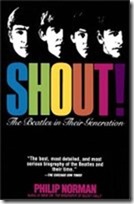 As these connected lines – drugs, drums, and demons – formed into obvious patterns in my mind I began to wonder if I could trace them visibly or nearly visibly in the lives of rock stars. For my first experiment I chose the most famous rock band to ever occupy a stage, the Quarrymen, otherwise known to history as the Beatles. As had become my custom, in addition to watching documentaries about their lives and clips of their concerts on You Tube, I also picked up a reputable biography of them. Shout, The Beatles in Their Generation by Philip Norman was my choice. Unlike with Guralnick's books on Elvis I purchased this one so I could make notations in the margin along the way. Published in 1981 and clocking in at over six hundred pages it is well reviewed. The Chicago Sun Times called it, "The best, most detailed, and most serious biography of the Beatles and their time." The New York Times was similarly effusive saying, "Nothing less than thrilling… the definitive biography."
It is relatively well known that by the end they were deeply enmeshed in the occult. The Beatles put Alistair Crowley (a drug-addicted, sex-obsessed anti-christ who pursued the occult passionately across Mexico, India, Egypt, and Europe) on the cover of the Sgt. Pepper album alongside their other heroes in 1967. In 1968 the Beatles sojourned in India for a time studying Eastern religion (which is occultic through and through) with the Maharishi. At the same time they spoke of delving into the Chinese Book of Changes, probably the oldest extant book on the occult in the world.
…but what about earlier? Could I or would I find a progression, or perhaps I should say a regression, of increased drug use along with demonic oppression as they transitioned from Liverpool school mates to the still most famous band in music history?
The answer is a resounding yes, and today's post is the proof. Here are a couple of thousand words worth of selections from Shout which chronicles the connection between their increasing and rampant drug use, their music, and their completely irrational behavior:
-(August, 1960; the still relatively unknown Beatles had left Liverpool to play the club circuit in Hamburg, Germany)
Someone in the early days had discovered Preludin, a brand of German slimming tablet which, while removing appetite, also roused the metabolism to goggle-eyed hyperactivity. Soon the Beatles - all but Pete Best - were gobbling 'Prellys' by the tubeful each night. As the pills took effect, they dried up the saliva, increasing the desire for beer.
Now the Beatles needed no exhortation to 'mak show.' John, in particular, began to go berserk on stage, prancing and growling...
…
Pete Best preferred not to take pills. When the others raced downstairs between spots to Rosa the WC attendant... when they clustered around the old woman in ankle socks, thrusting out Deutschmarks for Prellys from the sweet jar under desk, Pete Best would not be with them... Though perfectly amiable, and capable of drinking his share, he had showed himself to be devoid of the others' mad ebullience.
(not coincidentally, guess which Beatle never made the permanent cut…)
John would walk onstage at the Star-Club, naked, with a lavatory seat around his neck... John, each Sunday, would stand on the balcony, taunting the churchgoers as they walked up to St. Joseph's. He attached a water-filled contraceptive to an effigy of Jesus and hung it out for the churchgoers to see. Once, he urinated on the heads of three nuns.
'That was the sort of crazy thing you did, full of drink and pills,' Johnny Hutch says. 'Before we started playing at night, we'd shake Preludin down our throats by the tubeful. I've seen John Lennon foaming at the mouth, he's got so many pills inside him.'
-(Their first bass player was Stu Sutcliffe; he would die suddenly in 1962 of an unexplained brain aneurysm)
He existed for days without sleep, borne up by pills and drink and the feverish excitement of his work. The headaches, which had intermittently troubled him, began to increase, in frequency and ferocity. Sometimes the pain would send him into a kind of fit when he would smash his head against the wall or scream... A photograph taken at one such moment shows him half in shadow, his eyes frowning, sightless... It was that look which his college tutor, Edourdo Paolozzi, found especially disturbing, 'I felt there was a desperate thing about Stuart. I was afraid of it. I wouldn't go down to that club.'
...
For days at a time, she said, he would not come down from his attic to sleep or eat. And the headaches were sometimes so violent, they seemed more like fits...The Kirchherr family doctor, suspecting a brain tumor, sent him for X-rays. No tumor showed itself...The pain grew so intense at times that Astrid and her mother had to hold Stu down do stop him from throwing himself out of the window... Stu died in the ambulance, in Astrid's arms. 'At half-past four,' Millie Sutcliffe says, 'I was in my bedroom at home in Liverpool. I felt as if a great strong cold wind came through that house, lifted me up and laid me across the bed. For fifteen or twenty minutes, not a muscle in my body was capable of movement. That was the time, I discovered later, when Stuart was dying.'
-(later, in the early 60s, they graduated from Preludin to a wider variety of amphetamines)
Drugs occurred, like everything else, in almost wearisome profusion. The need dated from Hamburg and the months without sleep; it remained, amid the dizzying fame, to prop their eyes open through each night's arduous pleasure. Now the pills were bright-colored, like new clothes and cars - French Blues, Purple Hearts, Black Bombers and Yellow Submarines. The reflex grew in their growing boredom with everyday pleasure. More exciting than worship or sex, champagne or new toys, was to swallow a pill, just to see what would happen.
-(while shooting the film Help! in 1965; harder drugs make an appearance) 'They were high all the time we were shooting,' the director, Richard Lester, says.
...
'I saw it happen to Paul McCartney once,' Richard Lester says, 'the most beautiful girl I've ever seen, trying to persuade him to take heroin. It was an absolutely chilling exercise in controlled evil.'
'They were high all the time we were shooting,' the director, Richard Lester, says.
...
'I saw it happen to Paul McCartney once,' Richard Lester says, 'the most beautiful girl I've ever seen, trying to persuade him to take heroin. It was an absolutely chilling exercise in controlled evil.'
(-in 1965 they were first introduced to LSD; one video I watched described LSD as the drug that would let you see sounds and hear colors; not for nothing is it known as psychedelic; it is probably one of the most mind-altering drugs on the planet; this quote reveals their first encounter with it)
'It was as if we suddenly found ourselves in the middle of a horror film. The room seemed to get bigger and bigger. Our host seemed to change into a demon. We were all terrified. we knew it was something evil-we had to get out of the house. We got away somehow, in George's Mini, but he came after us in a taxi. It was like having the Devil following us in a taxi.
'We tried to drive to some club-the Speakeasy, I think it was. Four of us, packed into the Mini. Everybody seemed to be going mad. Patti wanted to get out and smash all the windows along Regent Street. Then we turned around and started heading for George's place on Esher. God knows how we got there. John was crying and banging his head against the wall.'
(December, 1966)
It was with 'Tomorrow Never Knows,' and songs after it, that the new John emerged. The new John 'dropped' LSD, the mind drug, as casually as he had once smoked a cigarette; for the new John, music was to be the means of passing on the visions he had seen...
Against a background of eerie twangling and squibbled backwards tapes, the voice intoned not a lyric but an exhortation. 'Turn off your mind, relax and float downstream... Lay down all thought, surrender to the void, it is shining, it is shining'...
...
He could lie there all day, not speaking to Cynthia, not seeming to notice Julian, his trance penetrable only by... some costly and purposeless toy like his 'nothing box,' a black plastic cube in which red lights winked on and off at random. He could spend hours in trying to guess which of the red lights would wink on next.
…
George, too, was now regularly taking LSD. For him, the mental landscape the drug produced was one he had already seen. It was the India of mystic sounds and mystic beings, able to levitate or lie on spikes or bury themselves:... he who had always kept his mind tight shut against all schooling now began to devour books about yoga and meditation. The books promised a state he had so far found unattainable-of perfect pleasure, 'enlightenment' and peace.
(August, 1967)
Strawberry Fields was the name of an old Salvation Army children's home close to where John grew up in Liverpool. The song was, however, explicit only in its title: a mirror only to its author's almost perpetual LSD trip...You heard it even better, people said, when you were high.
(about Brian, their manager, an open homosexual who died of an overdose in August, 1967)
The mounting depression, the chemicals warring within him, produced fits of irrational anger which drove Joanne many times to the point of resignation...'The smallest thing would send him half-crazy. I got him a wrong number once and he literally went berserk.'
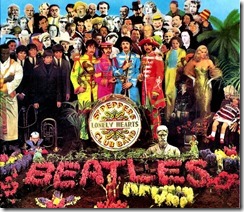 (about the production of 1967's Sgt. Pepper's Lonely Hearts Club Band)
Its strength lay in the fact that to all four Beatles, the vision was the same. All four were now converted to the LSD drug. Paul McCartney, the cautious, the proper, had at last given in... It would be remembered as their best record, and also their very best performance.
...
Martin, indeed, found his last reserves melting in admiration of a song like John's 'Lucy in the Sky With Diamonds,' whose images-of 'tangerine trees,' 'marmalade skies,' 'newspaper taxis' and 'looking-glass ties' - were dazzling enough to a man with his middle age senses intact. It did occur to him that sometimes John looked rather strange, if not actually unwell.
(Dr. Timothy Leary, the LSD apostles of the 60s, on the Sgt. Pepper album)
'I declare that the Beatles are mutants. Prototypes of evolutionary agents sent by God with a mysterious power to create a new species...They are the wisest, holiest, most effective avatars the human race has ever produced.'
...
Another, still deeper trough came in 1967, in the months before he met the Maharishi, when John, under Dr. Timothy Leary's influence, tried to destroy his ego... At a dinner party, given by Jane Asher, a guest happened to ask for an ash tray. John crawled under the table and invited her to flick her ash into his open mouth.
(John on his new love, Yoko Ono)
'As she was talking to me, I'd get high, and the discussion would get to such a level, I'd be getting higher and higher...Then I'd meet her again, and my head would go open, like I was on an acid trip.'
(May, 1969, John and Yoko)
This time, the press found them crouching on a table top inside a bag. It was, so John said, a demonstration of 'bagism' or 'total communication,' in which the speaker did not prejudice the listener by his personal appearance. More 'bagism,' he suggested, would generate more peace throughout the world. The British Daily Mirror spoke for the whole world in mourning 'a not inconsiderable talent who seems to have gone completely off his rocker.'
The sleeve this time showed Yoko in the hospital after her miscarriage, with John in his sleeping bag beside her bed. The tracks were screech and electronic scribble, and few seconds' heartbeat from the baby that had not survived... 'People think they're mad, both of them,' Ringo said, 'but that's not Yoko. That's just John being John.'
A new music based on the occultic rhythms of the West Africans Yorubans, and the spirit possession voodoo of Haiti? Check.
An increasing ingestion of harder and harder drugs? Check.
An increasingly bizarre behavior noticed and described so by all around them? Check.
A blatant self-professed connection between their music and the visions they received while taking drugs? Check.
Does that bother you as a Christian? Does it bother you that the most influential rock band in history was almost certainly under the direct influence of Satanic forces? …and people wonder why I want nothing to do with rock music, and why I aim to protect my children and my church from it at all costs.
I have said it before but it bears repeating: I am not interested in my music opening up the door of the occult in my mind.
Music is an emotional language. In the Bible it was used to empathize with others, amplify romance with a spouse, teach truth, motivate people, express inner emotions, reflect love of country, and to express prayer toward and prayer to the Lord.
As the twentieth century began Western music began to shift. Slowly over the first few decades with the introduction of ragtime, jazz, the blues, and rhythm and blues popular music began to leave the smoothness of its traditional flow behind and become something more raucous. Over time, as a dam is gradually weakened and then suddenly burst, popular music's slow migration to something wholly new became a sudden and massive shift. Elvis arrived at the same time that radio did, and Alan Freed almost singlehandedly launched the rock revolution into the hearts and minds of a new American demographic – teenagers. Visibly, audibly, practically overnight (though with a long list of factors leading up to it) rock music became the most dominant form of Western music and along with its various offshoots has continued as such without so much as a pause.
 Inarguably, rock is the primary musical style on the planet. Inarguably, the key element of rock music is the driving rhythm, the beat. There is a clear biblical link between worshipping evil spirits and the use of music. There is a massive pile of historical evidence that rock music both has its roots in such music and, indeed, its now in such music.
This blatant historical, factual, and continuing connection between rock music and the occult is not limited to or illustrated alone by the dominance of rhythm. The research of history and sociology both reveal other primary means of contacting the demonic spirit world, and some that are directly and heavily connected with rock music.
For instance, let us examine the use of mind altering chemicals, drugs in the common parlance. For millennia they have been used in a similar sense as rhythmic entrainment in order to alter states of consciousness, and to make the mind aware of things beyond or beside the physical, material universe.
This contention of mine – that there is a direct connection between the use of certain drugs and the opening up of the mind to the occult world – is not just a pet theory. It is proven in practice all around the world and has been for ages. Beyond that, and more importantly for the Christian, such a contention is established in the pages of the Word of God itself.
I do not have space within the limits of a blog post to walk you through all of the Scriptural allusions to and commandments regarding a Christian's duty to shun the spirit world. For the moment, then, let me just assume you understand this.
The practitioners of such arts are labeled in the King James Version variously as magicians, sorcerers, and witches. Amongst other means of contacting the spirit world such men and women used medicinal substances commonly known in their own day as potions. The English word potion is defined as "a drink or draft, especially one reputed to have medicinal, poisonous, or magical powers." It has its roots variously as many of our words do in Latin and Sanskrit terms that carry these meanings. While the word potion is not used in the King James Version there are three times in which its Greek equivalent is used in the New Testament.
Galatians 5.19 Now the works of the flesh are manifest, which are these; Adultery, fornication, uncleanness, lasciviousness,
20 Idolatry, witchcraft, hatred, variance, emulations, wrath, strife, seditions, heresies,
Revelation 9:21 Neither repented they of their murders, nor of their sorceries, nor of their fornication, nor of their thefts.
Revelation 18:23 And the light of a candle shall shine no more at all in thee; and the voice of the bridegroom and of the bride shall be heard no more at all in thee: for thy merchants were the great men of the earth; for by thy sorceries were all nations deceived.
Each of those three English words comes from some form of the Greek word which gives us our English word pharmacy. You read that correctly. Witchcraft and sorceries in the KJV are explicitly linked to drugs. The widely reputable Strong's Concordance defines it this way:
5331 φαρμακεια pharmakeia far-mak-i’-ah
from 5332; ; n f
AV-sorcery 2, witchcraft 1; 3
1) the use or the administering of drugs
2) poisoning
3) sorcery, magical arts, often found in connection with idolatry and fostered by it
…
5332 φαρμακευς pharmakeus far-mak-yoos’
from pharmakon (a drug, i.e. spell-giving potion); ; n m
AV-sorcerer 1; 1
1) one who prepares or uses magical remedies
2) sorcerer
This clear biblical link between drugs and the occult world is more than substantiated in our day.  Inarguably (I love that word because it conveys exactly what I intend it to), drug abuse has a greater foothold in rock music than in any other form of music, or indeed among any other kind of artists period. I do not have the time or the space to list the thousands of rock musicians who have been proven to use drugs, sung about drugs, or died of drug overdoses. The pure fact of that last sentence is so well entrenched that it has even birthed a cliché known to practically everyone on Earth – sex, drugs, and rock and roll.
…now is that not interesting? You do not find that said about any other kind of music. You do not find that said about any other type of creative artist. Why is there such a connection here? Very simply for this reason: if there is a connection between drums and the occult and if there is a connection between drugs and the occult then common sense tells you there will be a connection between drugs and drums.
That music? Rock music? You know, the music of choice for the average Westerner, the music that gets pumped into his head thousands of hours a year, the music that has revolutionized the world and almost singlehandedly birthed a culture of rebellion and sexual excess… that music is demonic to the core.
Yet in spite of all of these scriptural, historical, sociological, anthropological, and ethnomusicological facts I have piled up on this blog for the past eighteen thousand words some of you will continue to deny it.
You can run but you cannot hide. That music is following you, worming its way down into the deep parts of your heart, mind, and soul. And when it gets there it props a door open to a world any sane person in their right mind wants nothing to do with. Run, Christian, run. Flee to the Lord. Let Him be your strong tower. Let Him cast down the strong holds the devil has built into your life.
Isaiah 8:19 And when they shall say unto you, Seek unto them that have familiar spirits, And unto wizards that peep, and that mutter: Should not a people seek unto their God? For the living to the dead?
Note: too long of a post ahead of you here, but I cannot bring myself to stretch this portion of the series out into another week or three; this stuff is spiritually wearisome to wade through for me; read it or not, if you like, but ignore it at your own risk and I say that seriously.
 Sitting on my desk in front of me is a book that changed my life. That is not a claim I make for very many books. It provided well-researched in-depth confirmation of what was to me back then just a theory – namely, that rock music is a door to the occult world via percussion. Only later would I go on to see this substantiated via Michael Ventura's historical and critical essay on rock, Hear That Long Snake Moan. But the first and still most complete treatment of the fact is found in this book.
In 1965's flower-powered San Francisco the music was rockin'. From the foment of Haight-Ashbury's free love and easy drugs came a band that would play two thousand concerts and sell thirty five million albums in the next fifty years – the Grateful Dead. Originally called the Warlocks, they changed their name after discovering another band existed by the same name. Fronted by Jerry Garcia, by 1967 they counted among their number a young drummer named Mickey Hart.
Mickey Hart, born in 1943, came of age in the Sixties and embraced them with all the vigor and enthusiasm of youth. He remained with the band for the totality of its existence. In 1994 he and the rest of the band were inducted into the Rock and Roll Hall of Fame.
As the decades passed Mickey grew to become a world class drummer. Over time, as he traveled around the world playing with the band, he began to collect drums. His drum collection gradually developed into first a fascination and then a full blown obsession with the history of percussion in ancient cultures all around the globe.
In 1998 he published the results of his more than three decades of research as Drumming at the Edge of Magic: A Journey Into the Spirit of Percussion. It is a painstakingly researched synchronization of the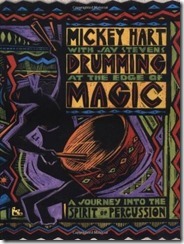 best of Western Civilization's doctorate level research and the myths and legends of ancient cultures. The Library Journal in a recommended review of it said in part, "His spell-binding drumming stories come from his studies and travels and his consultation with anthropologists, ethnomusicologists, and students of mythology, Joseph Campbell among them."
Mickey Hart owns more drums than any man in the world. He has played them in private and in public for tens of thousands of hours. He spent decades collating the legends, myths, and stories surrounding their use for millennia. No man on Earth knows more about drumming than Mickey. It would well behoove us to pay attention to what he says.
With today's lengthy post I will attempt to get you to do so. It consists mainly of a series of selected quotes. The purpose of these to establish in your mind the validity of my contention that rock music is a door to the occult via percussion. You may still disagree with me after reading this but you cannot do so from an uninformed perspective. You will only do so from a stubbornly obdurate one.
…from Chapter One: The Call of the Drum
-To all those who feel the power of the drum and don't know why.
-The most distinctive damarus are made from human skulls.
-"I hope you have been most careful, Mickey Hart. This is a drum of great, great power. It wakes the dead you know."
-It takes commitment and apprenticeship to learn how to find a drum's sweet spot. But once you do, the potential arises for contacting the drum's second voice – one I have come to think of as the spirit side of the drum. Exploring the spirit side of the drum has been the major adventure of my adulthood, if not my whole life.
 |
| Damaru skull drum |
-I would disappear into the studio for hours, for days, burning deeper and deeper into those perceptual states where the magical can happen.
-For almost as long as I can remember, playing the drum has stimulated certain changes in my consciousness.
-These instruments are capable of releasing certain energies that you contact only when you play.
…from Chapter Two: The Garden of Percussion
-He [James Blades, author of Percussion Instruments and Their History] would mention, for example, that the frame drum was played by North American shamans when they sang their power songs, but then offered no further information about the relationship of drums to shamanic power.
…from Chapter Three: The Hole in the Sky
-The last time I saw Joseph Campbell [author of The Way of the Animal Powers, mythologist, an intellectual follower of the more crass and evil Aleister Crowley] a few months before his death in 1987, he was as enthusiastic and entertaining as ever, inviting me to his home in Hawaii so we could finally sit down and crack open the mystery of shamans, the animal powers, and the drum.
-In his now-famous formulation, Joe used to put it this way: "Follow your bliss and doors will open where there were no doors before."
-He knew all about drums and ritual. He knew that you didn't find a shaman without finding a drum. Years earlier he had edited Maya Deren's classic account of Haitian vodun (or voodoo), The Divine Horsemen, remarking in his preface that nothing he had read had quite prepared him for Deren's personal account of possession trance, particularly "the power of the drums as they drove the god into the body of the devotee."
…from Chapter Six: Portrait of a Drummer as a Cold Warrior
-Just before enlisting I had discovered the music of Babatunde Olatunji, the Nigerian drummer who lives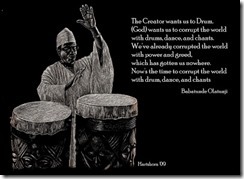 in New York. It was my first exposure to the mother rhythms from West Africa that later mutated into my tradition, becoming rock and roll. All I knew then was that whenever I played this music at one of Raphael's parties, the room would transform. It was as though the rhythm of the drum was calling up something from these sleek cosmopolitan bodies that had been asleep.
-One leave I traveled across North Africa. In Morocco I stumbled into a village that was celebrating the hashish harvest. The drumming had been going on for days, accompanied by big, loud, double-reed pipes. Everyone was smoking hash. In the square, dervishes danced themselves into trance, pushing thin, razor-sharp skewers through their cheeks. Someone told me that if the dancers felt pain, they weren't truly in trance.
…from Chapter Seven: Among the Ethnos
-When anthropologist John Roscoe came to Banzanhole, he found, at a little distance from the royal kraal, a small enclosure in which stood the hut of the royal drums… In front of the bed or stand was a row of pots belonging to the drums in which the daily offering of milk was put… The milk was placed there in the morning and remained there until nine or ten o'clock at night, by which time the drum spirits would have drunk their fill… Offerings of beer and cattle were made to the drums by chiefs…
-I played them on stage during that tour and when I got back to the Barn I discovered I couldn't stop playing them. They sent me into a deep trance state full of vivid hallucinations.
-During our first conversation I had told Fred [Lieberman, a professor and ethnomusicologist] about my belief that drums were intimately connected with altered states of consciousness. He'd said, "Percussion and transition." [link to the pdf] This, it turned out, was the name of a little debate that had been going on in social sciences since the last sixties when the eminent British anthropologist Rodney Needham had published a small essay with that title in the journal "Man", calling attention to the fact that percussion was almost universally used during such rituals of transition as birth, puberty, marriage, and death when the spirit world was called upon for guidance. Needham asked, "Why is noise that is produced by striking or shaking so widely used in order to communicate with the other world?" Fred and I picked up Needham on one of our feeding runs in the library. What fascinated me was the picture that emerged of the way information was shared among intellectuals. Needham hadn't pretended to know the answer; he was posing the question. The next issue of "Man" included several reasoned responses to Needham. A couple directed his attention to an article published a few years earlier in the field of acoustics, "A Physiological Explanation of Unusual Behavior in Ceremonies Involving Drums", [link to the pdf] authored by a psychologist named Andrew Neher. Studying drumming in a laboratory setting, Neher found that he was able to "drive" or "entrain" the brainwaves of his experimental subjects down into what is called the alpha/beta border, which means that a majority of the electrical activity in their brains was pulsing at a rate of between six and eight cycles per second… And it was this overload which helped induce trance.
…from Chapter Nine: Portrait of a Drummer at the Edge of Noise
-At the end of the set we all embraced, wordlessly. [Jerry] Garcia later told me that everyone had felt it when I finally synched up. Suddenly, with two drums pounding away in the back, they had glimpsed the possibility of a groove so monstrous it would eat the audience.
 -There was a physicality to the music that I hadn't noticed before. After a particularly loud set people couldn't walk or talk right; their speech was slurred. Sometimes head colds vanished.
-The band had rented a former movie star's castle in the Hollywood Hills, an enormous spooky building with damp concrete walls and winding staircases. Billy and I moved our drum pads into an empty room and stayed there for days. Employing some intensive hypnotic techniques I had learned, Kreutzmann and I now attempted to lock up at a deep level. We'd play for hours: I taught Billy what I knew of the rudiments, and he taught me how to rock.
I had heard, of course, of the phenomenon of rhythmic entrainment that rock and jazz musicians call "the groove." I had even fleetingly experienced it, but Billy taught me to trust in it, to let it draw me in like a tractor beam.
-A lot of these rhythms couldn't be married to the backbeat, but some mated pretty well; even when the rhythmic match went nowhere, there was always the One [a particular style of rhythm from India]. Every time we hit the One we got a little higher; the group groove grew a little deeper… Possessing that information allowed us to manipulate the echo to deepen the audience's rhythmic involvement.
Mickey Hart became good friends with a drummer from India named Zakir. Here is a bit of Zakir's story:
When I was seventeen I went to my first chilla, which is a ritual retreat. A musician is supposed to do three of them. A hut is prepared for you in a remote region, usually near the village of your guru's ancestors. For forty days you live in the hut, doing nothing but playing music.
The first one I did I thought would be easy. I bathed, recited the proper mantras, and then played my instruments for fifteen hours. A breeze. A drummer can take one rhythmic cycle, or tal, per day, or just play one tal for forty days.
By the second day the vibrations of the constant drumming were beginning to work on my consciousness. I saw things in the music that I'd never seen before, new combinations, new patterns. By the third day, however, I was starting to get bored. By the morning of the fourth day I did not want to touch my table. I forced myself to play. From the fifth day on I have little memory. I don't remember when I took a bath or ate. As soon as I began playing the visions would start. Everyone who does a chilla has these visions. They are an extension of the emotions, so that if I felt good, then these visions would be good. I'd heard stories of people who had had many bad experiences in life and when they went to do chillas their hallucinations were so scary they screamed – and the chilla was broken.
…I would have kept playing in this trance state perhaps forever if my father hadn't come to bring me home at the end of the fortieth day.
[Regarding his second chilla] The first ten days were like before, though now I was expecting visions. On the eleventh day, however, something strange happened. My table changed shape. It became a different instrument. It looked like a cross between a table and a big conga drum, except it also had eyes and a mouth, and it started talking to me… It reappeared throughout the next thirty days, sometimes terrifying me, always fascinating me. "It's an instrument," I kept telling myself. "An instrument can't hurt me; it's just a musical instrument. Why would a musical instrument want to hurt me?"
[Mickey's comment to Zakir about this experience] "Zakir, relax, it's okay, it's the groove! Let it move you."
…from Chapter Ten: Shaman's Drum: Skeleton Key to Other Worlds
-The warmth of the fire is said to burn away the fog from the novice's eyes, so they can see their spirit allies and learn the songs they are supposed to sing to them.
-When the ritual is about to begin, the shaman picks up his drum, warms it over the fire to give the skin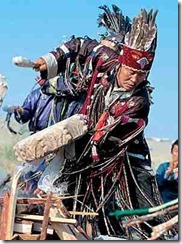 its proper tension, and then sits down with it on his left knee and strikes the rim with his drumstick. All conversation ceases.
The shaman begins the first song, an invocation to the spirits. After each verse, everyone present sings a rhythmic refrain. As the song progresses the shaman begins to call on his spirit allies. He names each of them and describes their power and the services they have rendered to the tribe. He tells them how he sees them leaving their homes and coming to his isolated spot.
The drumming becomes softer and the song is interrupted by the sound of the spirits, grunts and whistles, and the whirring of wings… The dialogue between ancestor spirit and ally is heard by all since it comes out of the shaman's mouth in the form of screams, grunts, and yells.
The drumming grows thunderous. Suddenly the shaman leaps to his feet. He sways from side to side, bending low and straightening, then he "looses such a torrent of sound on the audience that it seems everything is humming – the poles of the tent, even the buttons of those present."
Throwing his drum to his assistant, the shaman's song rises to a scream and he begins to dance, pantomiming the journey of his ally in the underworld. He whirls and spins, he foams at the mouth, then he drops down and lies like one stricken. He is in deep trance. Having joined his ally in the underworld, he is no longer in this time.
Urgently his assistant grabs the drum, warms it over the fire and begins to beat it vigorously, calling to the shaman not to get lost in that dangerous land. Look at the fire, he yells. Listen to the drum so you can find your way back!
The drum becomes louder and louder. Suddenly the shaman screams. He leaps to his feet and begins dancing for the return of his chief ally. Presumably he now knows the nature of the bad spirit that is causing his patient's sickness.
its proper tension, and then sits down with it on his left knee and strikes the rim with his drumstick. All conversation ceases.
The shaman begins the first song, an invocation to the spirits. After each verse, everyone present sings a rhythmic refrain. As the song progresses the shaman begins to call on his spirit allies. He names each of them and describes their power and the services they have rendered to the tribe. He tells them how he sees them leaving their homes and coming to his isolated spot.
The drumming becomes softer and the song is interrupted by the sound of the spirits, grunts and whistles, and the whirring of wings… The dialogue between ancestor spirit and ally is heard by all since it comes out of the shaman's mouth in the form of screams, grunts, and yells.
The drumming grows thunderous. Suddenly the shaman leaps to his feet. He sways from side to side, bending low and straightening, then he "looses such a torrent of sound on the audience that it seems everything is humming – the poles of the tent, even the buttons of those present."
Throwing his drum to his assistant, the shaman's song rises to a scream and he begins to dance, pantomiming the journey of his ally in the underworld. He whirls and spins, he foams at the mouth, then he drops down and lies like one stricken. He is in deep trance. Having joined his ally in the underworld, he is no longer in this time.
Urgently his assistant grabs the drum, warms it over the fire and begins to beat it vigorously, calling to the shaman not to get lost in that dangerous land. Look at the fire, he yells. Listen to the drum so you can find your way back!
The drum becomes louder and louder. Suddenly the shaman screams. He leaps to his feet and begins dancing for the return of his chief ally. Presumably he now knows the nature of the bad spirit that is causing his patient's sickness.
-The word "shaman" comes from… individuals in the tribe who can enter into a trance in order to commune with the spirit world.
-For the shaman, the drum is not so much a musical instrument as a vehicle for transportation.
-…to be perfectly honest, what first caught my attention with regard to shamans were their drums. Shamans are drummers – they're rhythmists, they're trance masters who understood something fundamental about the nature of the drum, something I badly wanted to learn.
I noticed, as I began to study the anthropological debate over percussion and transition, that most of the examples of percussive trance fell into two broad categories. In the first, drumming was used to summon the spirits or the gods down into the body of someone other than the drummer, usually a dancer. This is known as possession trance. The classic example is vodun, where the spirits – called the loa – are said to descend and mount the bodies of the dancers and ride them like horses.
The second type of trance is shamanic or "communion trance," the opposite of possession trance in almost every way. In a communion trance the spirit or soul of the drummer is said to ride his drumbeat like a horse up to the spirit world, where he transacts business in an active rather than a passive way.
-…shamans are people who have developed techniques that allow them to enter esoteric states of consciousness. In modern psychological jargon, they are individuals who mastered lucid dreaming, clairvoyance, clairsentience, out of body travel – the whole spectrum of what psychiatrist Stan Grof calls "nonordinary states of consciousness." Shamans can be thought of as individuals who have learned how consciously to enter some of these states and then bring back to this reality the information they obtain there.
-…it does, however, take a healthy, robust mind to go into trance, with ease, on a regular basis. People in different ethnic groups distinguish very well between those who are mentally ill and those who are shamans.
-Among the Ainu of Japan, a woman falls with a traditional female nervous disease… if she succeeds in curing herself – that is, drives the bad spirit from her body – then a good spirit will come to live near her. The spirit might be that of a snake, a fox, or a caterpillar. When the woman enters a trance state, this spirit will speak to her and tell her the nature of the illness of those who now come to her to be cured.
-Not only do the shaman's receive their songs from the spirit world, but most of the instruments they play as well. According to the Warao of Venezuala, the gourd rattle they use in their rituals was obtained many years ago from the spirit of the South by an ancestral shaman: "During his visit he received the sacred fire rattle and was given instructions about the creation of channels of communication with the supernatural so that he and his kind might never lose contact with the gods of the cardinal directions."
-The Khakass shaman does not make his own drum. In a trance he receives special instructions from the "masters of the holy mountain", which he then imparts to the members of his tribe who are responsible for building the drum…
-The birch handgrip is called "mars", meaning tiger, and it represents the master spirit of the drum. These are the eyes of the tiger. It is through those eyes that the shaman's spirit allies enter and depart from the drum. When they are inside the drum, the shaman enjoys their power.
-The shaman now takes up his new drum for the first time and examines it to make sure his instructions have been precisely followed. Then he goes into trance and rides the World Tree to show his drum to the Lord of the Universe, who in turn makes sure that all his instructions have been carried out. If the drum is approved, then the Lord of the Universe assigns the shaman his animal allies.
-When the shaman's drum dies, so does the shaman's power, and frequently so does the shaman.
…from Chapter Twelve: Africa: The Invisible Counterplayers
-Frobenius [early 20th century ethnologist] felt that the Yoruba of West Africa were the most spiritual people in the world. I don't know about that, but I think it's safe to say that Africans, particularly West Africans, are probably the most rhythmical, in the sense that an awareness and appreciation of rhythm is the mainstay of their culture.
-African rhythm, he [Erich von Hornbostel, early 20th century musicologist] wrote, was "syncopated past comprehension."
 -Not all possessing spirits are Orisha [what West Africans deem to be good, ancestor based spirits], and you don't want to be possessed by just any spirit, so great care must be taken that only the correct spirit takes up residence. The way this is accomplished is with the drum. Particular rhythms are supposed to attract particular spirits. An Orisha like Shango only comes when he hears his rhythm.
The most powerful trance rhythms belong to secret societies, which handle all communications between this world and the spirit world. The Yewe secret society of West Africa has seven different types of drum rhythms that accompany the sect's seven special dances and attract seven different spirits.
-Not all possessing spirits are Orisha [what West Africans deem to be good, ancestor based spirits], and you don't want to be possessed by just any spirit, so great care must be taken that only the correct spirit takes up residence. The way this is accomplished is with the drum. Particular rhythms are supposed to attract particular spirits. An Orisha like Shango only comes when he hears his rhythm.
The most powerful trance rhythms belong to secret societies, which handle all communications between this world and the spirit world. The Yewe secret society of West Africa has seven different types of drum rhythms that accompany the sect's seven special dances and attract seven different spirits.
-Not much has been written about what goes on during these initiation rites, but bits and pieces can be found in literature, particularly in some of the New World appearances of the possession sects, like candombe, vodun, and Santeria. Some of these sects seem to have discovered ways to keep their young initiates in trance for months.
-McCall's [David, author of West Africa and the Eurasian Ecumene] thesis that the West Africa possession trance cultures were actually a remnant of the Neolithic mother goddess tradition reminded me of something I had read in Gilbert Rouge's Music and Trance. In his chapter on the ancient Greeks, Rouget had gone to great lengths to prove that many of the ecstatic religions that had so annoyed Greek rationalists like Plato were in fact possession cults. The Greeks had known four different kinds of trance: erotic trance, poetic trance, mantic trance, and something Socrates called telestic trance. According to Rouget, this last trance, which comes from the Greek "teletai", meaning ritual, was a possession trance. Amidst frenzied dancing, which Pluto in The Republic banned as "unfit for our citizens", the spirits of the cult came down and took up residence in the bodies of the dancers.
What Rouget had not bothered to explore was the interesting fact that all of these possession cults – the Corybantes, the Bacchantes, the cult of Cybele, the Dionysian cults – were all surviving fragments of the ancient goddess religions, all of them trance possession cultures in which drums were probably the driving mechanism. At one point in the play "The Bacchae", Dionysius cries out, "O my sisterhood of worshippers, whom I lead with me from barbaric countries… Raise the music of your own country, the Phrgian drums invented by Rhea the Great Mother, and by me."
-Was there, immediately prior to Western "history", a drum-driven possession trance culture that worshiped the earth in the form of the Great Mother? Suddenly a lot of things clicked into place.
-I remembered Gimbutas writing that there was "an intimate relation between the drum and the mother goddess."
-It literally disappears from our history, is all but wiped out, except for the bit of it
– if McCall is correct – that withdraws into the West African forest, nurturing a culture that Leo Frobenius will one day call the most spiritual of the world.
- When slave ships began plying the waters between the New World and West Africa, everyone thought they were just carrying strong, expendable bodies. But they were also carrying the Counterplayer culture – maybe even the mother goddess culture – preserved in the form of drum rhythms that could call down the Orisha from their time to ours. In the Caribbean and South America, slaves were allowed to keep their drums and thus preserve their vital connection with the Orisha, though the the sudden mingling produced new variations like candomble, Santeria, and vodun.
-And out of this severing came jazz, the blue, the back beat, rhythm and blues, rock and roll – some of the most powerful rhythms on the planet.
…from Chapter Thirteen: The Brotherhood of the Drum
-It is hard to pinpoint the exact moment when I awoke to the fact that my tradition – rock and roll – did have a spirit side, that there was a branch of the family that had maintained the ancient connection between the drum and the gods. I suppose it was a little like meeting some long lost cousins and realizing with a start that these are your relatives, that you are rhythmically related, and in drumming that's the same as blood.
-[quote from Babatunde Olatunji, famous Nigerian drummer] But the most important rhythms in Yoruba land are those that communicate with the Orisha… There are several ways of celebrating these Orisha. Sometimes we make sacrifices at the shrine of the Orisha and offer them gifts. Or else a feast with drumming and dancing is planned, and as we chant and dance, some of the people will become possessed by the spirit, of, say, Ogun or Shango and be transformed to a higher spiritual level.
-[still quoting Olatunji] But when I got to college and first turned on the radio and herd, "When I love my baby, every time it rains I think of you and I feel blue", I was so stunned. I remember thinking, hey that's African music; it sounds like what's at home."
So there it is – a summation of the book that is sitting on my desk that changed my life. What I had long suspected about rock music and its present connection to an ancient demonism had been proven in excruciating detail. And not by some wild eyed ignorant Baptist preacher, but by the rock drummer of our age who knows more about drumming than any other man on the planet. I will leave you with one last quote from Mickey Hart. I urge you to let it soak in for a while…
None of my friends talked about shamans, and yet that's what we were all trying to become, without knowing it.

 first topped the charts with a rock song in 1955 did so in the context of a movie soundtrack, MGM's Blackboard Jungle, which purposely attempting to display the "teenage savagery" of a rebellious group of inner city young people. Cliff Richard, in 1961's The Young Ones belted out


