Sunday, September 23, 2018

The Brazen Altar

The Tabernacle 3

Note: These kinds of studies, types and figures, et al, often find one man slightly disagreeing with another. If you disagree with my conclusions in this series and your disagreement is an educated one I welcome hearing it. Perhaps you may help me. Hopefully, along the way, I will help you too.

Exodus 38:1–7 310px-High_Priest_Offering_Sacrifice_of_a_Goat
1 And he made the altar of burnt offering of shittim wood: five cubits was the length thereof, and five cubits the breadth thereof; it was foursquare; and three cubits the height thereof.
2 And he made the horns thereof on the four corners of it; the horns thereof were of the same: and he overlaid it with brass.
3 And he made all the vessels of the altar, the pots, and the shovels, and the basons, and the fleshhooks, and the firepans: all the vessels thereof made he of brass.
4 And he made for the altar a brasen grate of network under the compass thereof beneath unto the midst of it.
5 And he cast four rings for the four ends of the grate of brass, to be places for the staves.
6 And he made the staves of shittim wood, and overlaid them with brass.
7 And he put the staves into the rings on the sides of the altar, to bear it withal; he made the altar hollow with boards.

You have sinned. You took a blood oath, a covenant oath, to observe to do all that Moses said God commanded, but you failed. You wanted to obey. You tried. You love and fear Jehovah, and in gratitude to Him for rescuing you and your family from Egypt you want more than anything to please Him. But still you failed. You violated His commandments. And you feel rotten about it.

Stepping out of your tent into the rising sun of dawn you hope this day will be different, that you will get your act together and keep it together. But doubt gnaws at you. In your heart of hearts you know that today you will sin too. It seems unstoppable, no matter your good intentions and best efforts. Disconsolately, you kick the sand. You wander aimlessly around the encampment. Should you talk to an elder? Should you buck up and soldier on? Should you forget it all, stop worrying about it? Impossible. It eats at Whale_Shark_in_Shallow_Wateryou, this sin of yours, shredding your piece of mind like you feared those sharks you saw in the walls of water around you would shred you as you walked the floor of the Red Sea.

What’s that? Someone is calling your name? Looking up you see the Doorkeeper. Standing in front of the ornate curtained entrance to the Tabernacle he is asking you if you would like to come inside, make an offering perhaps. Should you? Dare you? Won’t Moses find out? Won’t Aaron be angry with you? Won’t the priests on duty take one look at you and turn away in disgust?

You stop. Pause is a better word, debating whether this is a tragic mistake or a good idea. Undecided, you feel the warmness in the Doorkeeper’s invitation seep around the edges of your cold fear. Turning, you take a step toward the entrance. But will it do any good? Will this change anything?

This is it. You have reached the entrance. What will you do? Screwing your courage to the sticking point you step over the thresh hold. Into salvation, redemption, and righteousness. And right before you eyes you see it, the Brazen Altar. Five cubits square and three high, how 350px-Book_of_Exodus_Chapter_28-2_(Bible_Illustrations_by_Sweet_Media)could you possibly miss it? Gleaming a soft bronze color in the early light, smoke still curling up from the morning sacrifice held in place by the horned corners, it draws you like a lodestone.

As a Jew, you know your history. It has been drilled into you on the green banks of the Nile. Father Abraham walking Isaac up to Mount Moriah only to find Jehovah replacing his son with a ram. Jacob at Bethel. Pondering, you recalled what you had recently heard Moses say. Behold, all souls are mine; as the soul of the father, so also the soul of the son is mine: the soul that sinneth it shall die. The soul that sinneth it shall die. The son shall not bear the iniquity of the father, neither shall the father bear the iniquity of the son: the righteousness of the righteous shall be upon him, and the wickedness of the wicked shall be upon him. (Exodus 18.4, 20) Where there is sin there must be death, and nothing said “death” like the enormous altar in front of you.

…and that, to my understanding, was exactly the point of the Brazen Altar. Gory, burning, stinging the eyes with its smoke, it screamed the death that was necessary to cover sin. If the whole idea of a sacrifice was to cause God to overlook a person’s sin then that sacrifice had to involve death. This is seen not only in the Jews earliest history, but in humanity’s history, which the Jews were obviously familiar with. Adam and Eve sinned. To cover them with skins required death.

The Jewish religion was such a bloody religion precisely because it was designed to point to this aspect of their future Messiah – His death. It was absolutely critical that they understand this so God gave them a process that declared it to them again and again and again. And almost all things are by the law purged with blood; and without shedding of blood is no remission. (Hebrews 9.22)

Ask me what is the saddest thing about the Jewish people and I will tell you this: in spite of their zeal and knowledge in the things of Jehovah they have totally missed the point of their own Messiah. As a result, they rebelliously refused to accept Him when He arrived. They wanted an earthly deliverer, someone who would subdue Rome and raise them to the pinnacle of the world. Their Messiah wanted to deliver them from their sins, and raise them to the pinnacle of Heaven. But under no condition should they have missed this. Jesus said exactly this to Nicodemus, Art thou a master of Israel, and knowest not these things? (John 3.10)

In addition to the impossible-to-miss illustration of the Brazen Altar, the necessary death of the Messiah for the people’s sins was explicitly stated by the greatest preacher of the Old Testament.

Isaiah 53:1–9
1 Who hath believed our report? And to whom is the arm of the LORD revealed?
2 For he shall grow up before him as a tender plant, And as a root out of a dry ground: He hath no form nor comeliness; And when we shall see him, there is no beauty that we should desire him.
3 He is despised and rejected of men; A man of sorrows, and acquainted with grief: And we hid as it were our faces from him; He was despised, and we esteemed him not.
4 Surely he hath borne our griefs, And carried our sorrows: Yet we did esteem him stricken, Smitten of God, and afflicted.
5 But he was wounded for our transgressions, He was bruised for our iniquities: The chastisement of our peace was upon him; And with his stripes we are healed.
6 All we like sheep have gone astray; We have turned every one to his own way; And the LORD hath laid on him the iniquity of us all.
7 He was oppressed, and he was afflicted, Yet he opened not his mouth: He is brought as a lamb to the slaughter, And as a sheep before her shearers is dumb, So he openeth not his mouth.
8 He was taken from prison and from judgment: And who shall declare his generation? For he was cut off out of the land of the living: For the transgression of my people was he stricken.
9 And he made his grave with the wicked, And with the rich in his death; Because he had done no violence, Neither was any deceit in his mouth.

2018-05-31 14.38.30This is why it is good for us to keep the cross front and center in our Christianity. That sacrificial death was absolutely necessary, for them and for us. No wonder the Tabernacle was structured in such a way as to remind the Jews of that – every single day.

Where there is sin there must be death. Mine or His. The Brazen Altar proves it.





Sunday, September 16, 2018

The Courtyard

The Tabernacle 2

Note: These kinds of studies, types and figures, et al, often find one man slightly disagreeing with another. If you disagree with my conclusions in this series and your disagreement is an educated one I welcome hearing it. Perhaps you may help me. Hopefully, along the way, I will help you too.
_______________________________________________________________________

Any study of the Tabernacle will, almost by default, involve an examination of much Scripture. After all, we are attempting to discover what different aspects of it referenced regarding the work of Christ and we do not want to do that with opinion. Of necessity, then, this short blog series will involve more scripture selections than I normally use in writing. I cannot bring myself to apologize for it and I am sure you would not desire me to do so.
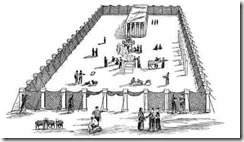
CourtLet us begin with the instructions Moses received regarding the exterior of the Tabernacle. I have chosen to call this the courtyard.

Exodus 27:9–18
9 And thou shalt make the court of the tabernacle: for the south side southward there shall be hangings for the court of fine twined linen of an hundred cubits long for one side:
10 And the twenty pillars thereof and their twenty sockets shall be of brass; the hooks of the pillars and their fillets shall be of silver.
11 And likewise for the north side in length there shall be hangings of an hundred cubits long, and his twenty pillars and their twenty sockets of brass; the hooks of the pillars and their fillets of silver.
12 And for the breadth of the court on the west side shall be hangings of fifty cubits: their pillars ten, and their sockets ten.
13 And the breadth of the court on the east side eastward shall be fifty cubits.
14 The hangings of one side of the gate shall be fifteen cubits: their pillars three, and their sockets three.
15 And on the other side shall be hangings fifteen cubits: their pillars three, and their sockets three.
16 And for the gate of the court shall be an hanging of twenty cubits, of blue, and purple, and scarlet, and fine twined linen, wrought with needlework: and their pillars shall be four, and their sockets four.
17 All the pillars round about the court shall be filleted with silver; their hooks shall be of silver, and their sockets of brass.
18 The length of the court shall be an hundred cubits, and the breadth fifty every where, and the height five cubits of fine twined linen, and their sockets of brass.

I believe the entrance itself was designed by Jehovah to represent the salvation that is in Christ. Jesus would later assert, I am the door: by me if any man enter in, he shall be saved, and shall go in and out, and find pasture. (John 10.9) The gate faced east so that those who entered for the morning sacrifice did so in the light. The gate was the only way of access; there was no other way in at all. Thus, the gate was designed for everybody – rich, poor, priest, Levite, Jew, proselyte – all had to come in the same way. Included in this “whosever” gate especially were those who were sinners. They did not have to clean up first. They came through that gate in order to be cleansed. And it only took one step to get inside. It was not a process; it was instantaneous.

Let us turn our attention now to the linen material that formed the fence around the courtyard. The length of the court shall be an hundred cubits, and the breadth fifty every where, and the height five cubits of fine twined linen, and their sockets of brass. (Exodus 27.18) This purified white linen, marred by no imperfection or flaw or stain, represented the righteousness that is to be found in Christ. At His transfiguration we are told, And his raiment became shining, exceeding white as snow; so as no fuller on earth can white them. (Mark 9.3) That moment of glory pulled back the curtain of Jesus’ flesh and revealed to those around His essential moral purity, His absolute holiness. This is in direct contrast to the Biblical illustration of filthy garments as representative of sin. But we all as an unclean thing, and all our righteousness are as filthy rags; and we all do fade as a leaf; and our iniquities, like the wind, have taken us away. (Isaiah 64.6) To the contrary, when the wind blew Tabernacle-model-and-courtyard,-tb030807082-bibleplacesaround the Tabernacle those billowing walls of pure white were securely anchored in place. Step inside the gate – salvation – and you immediately find yourself surrounded by the white linen of righteousness.

We find this illustration from one end of Scripture to the other, but especially in Revelation.

3.4 Thou hast a few names even in Sardis which have not defiled their garments; and they shall walk with me in white: for they are worthy.
5 He that overcometh, the same shall be clothed in white raiment; and I will not blot out his name out of the book of life, but I will confess his name before my Father, and before his angels.
…
6.9 And when he had opened the fifth seal, I saw under the altar the souls of them that were slain for the word of God, and for the testimony which they held:
10 And they cried with a loud voice, saying, How long, O Lord, holy and true, dost thou not judge and avenge our blood on them that dwell on the earth?
11 And white robes were given unto every one of them; and it was said unto them, that they should rest yet for a little season, until their fellowservants also and their brethren, that should be killed as they were, should be fulfilled.
…
7.13 And one of the elders answered, saying unto me, What are these which are arrayed in white robes? and whence came they?
14 And I said unto him, Sir, thou knowest. And he said to me, These are they which came out of great tribulation, and have washed their robes, and made them white in the blood of the Lamb.
…
19.8 And to her was granted that she should be arrayed in fine linen, clean and white: for the fine linen is the righteousness of saints.
…
19.14 And the armies which were in heaven followed him upon white horses, clothed in fine linen, white and clean.

Without a doubt, these linen walls represented righteousness, and the only way into that righteousness was via salvation. Once we come to Christ to solve our sin problem we will find ourselves completely enclosed in the perfect righteousness of that Saviour. What precious thoughts!

In addition to the gate and the linen fence we see a third metaphor of Christ in the courtyard, namely the purified silver metal that gleamed here and there in between the linen. Anchored to wooden supports, it supported those linen walls. I believe this silver represents the redemption from sin that Christ would bring.

Exodus 36:24–26
24 And forty sockets of silver he made under the twenty boards; two sockets under one board for his two tenons, and two sockets under another board for his two tenons.
25 And for the other side of the tabernacle, which is toward the north corner, he made twenty boards,
26 And their forty sockets of silver; two sockets under one board, and two sockets under another board.

I do not want to press this illustration too hard, but the context of what silver was used for in Moses’ day is interesting. A massive slave horde exited Egypt in a tremendous hurry on the day after Passover, and they had experienced precious little peace and quiet since. The pause at Mt. Sinai was not just for religious reasons; it was also for organizational reasons. A society, albeit a mobile one, needed to be standardized out of the chaos of the exodus. To that end, God instructed Moses to count and tax each adult male. This tax was to be paid at the Tabernacle and was called “atonement money”. Every adult male paid the exact same amount, a half shekel.


smallExodus 30:11–16
11 And the LORD spake unto Moses, saying,
12 When thou takest the sum of the children of Israel after their number, then shall they give every man a ransom for his soul unto the LORD, when thou numberest them; that there be no plague among them, when thou numberest them.
13 This they shall give, every one that passeth among them that are numbered, half a shekel after the shekel of the sanctuary: (a shekel is twenty gerahs:) an half shekel shall be the offering of the LORD.
14 Every one that passeth among them that are numbered, from twenty years old and above, shall give an offering unto the LORD.
15 The rich shall not give more, and the poor shall not give less than half a shekel, when they give an offering unto the LORD, to make an atonement for your souls.
16 And thou shalt take the atonement money of the children of Israel, and shalt appoint it for the service of the tabernacle of the congregation; that it may be a memorial unto the children of Israel before the LORD, to make an atonement for your souls.

Much more would be said by Moses soon regarding this thing of atonement, but for the moment let us note that it was paid to the Tabernacle, and paid in silver. And it was these same silver half-shekels that were melted down and used to form the socket supports for the boards that held up the linen walls of the Tabernacle courtyard.

Exodus 38:25–27 (KJV 1900)
25 And the silver of them that were numbered of the congregation was an hundred talents, and a thousand seven hundred and threescore and fifteen shekels, after the shekel of the sanctuary:
26 A bekah for every man, that is, half a shekel, after the shekel of the sanctuary, for every one that went to be numbered, from twenty years old and upward, for six hundred thousand and three thousand and five hundred and fifty men.
27 And of the hundred talents of silver were cast the sockets of the sanctuary, and the sockets of the vail; an hundred sockets of the hundred talents, a talent for a socket.

This head tax, for lack of a better phrase, continued to be required on an on-going basis as the family’s oldest boy reached his maturity. Initially, Jehovah required the service of the eldest son in each family and when He later shifted that service requirement to the Levites as a class the oldest son in each family in Israel was required to pay this tax as a sign he was opted out of service. Later, we find it labeled “redemption money.”

Numbers 3:46–51
46 And for those that are to be redeemed of the two hundred and threescore and thirteen of the firstborn of the children of Israel, which are more than the Levites;
47 Thou shalt even take five shekels apiece by the poll, after the shekel of the sanctuary shalt thou take them: (the shekel is twenty gerahs:)
48 And thou shalt give the money, wherewith the odd number of them is to be redeemed, unto Aaron and to his sons.
49 And Moses took the redemption money of them that were over and above them that were redeemed by the Levites:
50 Of the firstborn of the children of Israel took he the money; a thousand three hundred and threescore and five shekels, after the shekel of the sanctuary:
51 And Moses gave the money of them that were redeemed unto Aaron and to his sons, according to the word of the LORD, as the LORD commanded Moses.

In such a context it is not hard to understand why I have redeemedlabeled silver as a symbol of our purchased redemption. There was no exception to this price. This was the only price. Nothing different was accepted. Nothing beyond this was needed. 

In summary, as you step into the Tabernacle courtyard you come through the gate, which represents the salvation that is only available in Christ. You are then enveloped in the beautifully white linen of righteousness, Christ’s righteousness not your own. This righteousness was based on or supported by the silver sockets of your redemption through Christ’s death, a death that atoned for your sin. Now if that is not a pretty picture of Jesus Christ and what He does for the transgressor I do not know what is.


What is our part? To receive it, and to urge people to enter into it. The psalmist said, For a day in thy courts is better than a thousand. I had rather be a doorkeeper in the house of my God, than to dwell in the tents of wickedness. (Psalm 84.10) As I understand it, the doorkeeper was not there primarily to keep the undeserving out. After all, every one who entered was undeserving. No, I believe the doorkeeper was there at the gate to urge people to come in, to welcome them to take that step, to cross the threshold of salvation and enter into the spotless righteousness obtained by redemption’s price. What a grand thing to be a doorkeeper!

…and this is just the fence that creates the courtyard around the structure.


Sunday, September 9, 2018

Why We Should Study the Tabernacle

The Tabernacle 1

Three thousand four hundred years ago the Jews built a tent Stiftshuette_Modell_Timnapark (1)in the middle of nowhere, anchoring it into the dry blowing sand that is the Sinai Peninsula. That tent, known in Scripture as the Tabernacle, was the center of their worship of God. I am not a Jew. I do not follow the Old Testament system of worship. Hebrews clearly and repeatedly tells us that what we have as the Church is better. So why should I care about the Tabernacle?

First of all, I should pay attention to the Tabernacle in order to help me to better understand the stories that take place in the Old Testament. As the Temple would be later, the Tabernacle was what everything else revolved around for the devout Jew of the day. It was of primary importance in the biblical stories that take place between Exodus and Deuteronomy and figures prominently in many books of the Bible after that. If I want to learn from those Old Testament stories I must understand them, and if I am to understand them well I must grasp the day and time in which they lived. It is easier to enter into their lives, to view them as real people if I have immersed myself in their world. If I do that, it is easier to understand their choices, good or bad, and it is easier to understand what those choices represented. It is easier to understand just how and why exactly God responded to those choices the way He did. In short, paying attention to the Tabernacle will help me to learn more from those Exodus era stories.

Second, I should pay attention to the Tabernacle so that I may better understand salvation, not just in the Old Testament, but also in the New Testament.

The writer of Hebrews tells me that the Tabernacle was a picture, a living three-dimensional image, of the Temple in Heaven, and that its worship was an earthly representation of heavenly truth.

Hebrews 8:1–5
1 Now of the things which we have spoken this is the sum: We have such an high priest, who is set on the right hand of the throne of the Majesty in the heavens;
2 A minister of the sanctuary, and of the true tabernacle, which the Lord pitched, and not man.
3 For every high priest is ordained to offer gifts and sacrifices: wherefore it is of necessity that this man have somewhat also to offer.
4 For if he were on earth, he should not be a priest, seeing that there are priests that offer gifts according to the law:
5 Who serve unto the example and shadow of heavenly things, as Moses was admonished of God when he was about to make the tabernacle: for, See, saith he, that thou make all things according to the pattern shewed to thee in the mount.

thThe New Testament is birthed out of the Old Testament. As Christians, birthed in the New Testament, we must realize that we have Old Testament DNA in our genetic code. Specifically, the Tabernacle is referenced more than 300 times in the Bible, and in the New Testament is used again and again to illustrate some aspect of salvation. If you do not have a decently studied understanding of the Tabernacle most of these illustrations and understandings and their corresponding appreciation will be lost on you. As has been long said, in the Old Testament the New lies hid, and in the New Testament the Old lies open.

Third, I should pay attention to the Tabernacle because there is truth there. Paul tells us that all Scripture is… profitable. (II Timothy 3.16) Surely, that includes the many chapters that discuss the Tabernacle in exquisite detail. More to the point, he pointedly told the Church age that they needed to pay attention to the Old Testament and what it contained. For whatsoever things were written aforetime were written for our learning, that we through patience and comfort of the scriptures might have hope. (Romans 15.4)

The Bible is the revelation of God to man. In other words, every part of the Word of God tells me something about God and about God’s expectations of me. For me to skip major parts of it because I think it is old, or I think it no longer applies in our day is shortsighted and unscriptural. No, I do not build my doctrinal concept of the Church out of the Old Testament because the Church is a New Testament institution. But I do take the Old Testament to be just as much the inspired, preserved Word of God as I do the New Testament. And even the finer points of that Old Testament revelation are worthy of examination for they reveal God to me.

Last, and most importantly, I should pay attention to the Tabernacle because I love Jesus, and I want to know everything about Him that I can.

In the nineteenth century the British navy civilized the globe. In Arthur Herman’s 1975 work, “To Rule the Waves: How 971931the British Navy Shaped the Modern World”, he discusses at some length the technology that went into making that Royal Navy function. Who knew that they seasoned pine trees underwater in Scotland for years before turning them into masts? In the process of discussing this he discussed rope. The Royal Navy used miles and miles of it, an almost endless amount being necessary to properly rig everything from a schooner to a three-decked ship of the line during the era of sail power. Rope was also necessary for England’s vast merchant marine, and furthermore, was relatively easy to steal. How to tell if the rope sitting on some barque sailing to the Azores with tea had been lifted from the Royal Navy’s dockyard? Cut it. Anywhere. Why? Because the navy’s rope had a scarlet thread bound through it, every inch on every ship, for precisely that purpose. A rope with a scarlet thread in it belonged to the Royal Navy, period.

In the Scripture there is a scarlet thread of redemption woven from one end to the other. Open the Bible anywhere, cut into it at any place, yea even the Old Testament, and you will almost immediately see Jesus. In Genesis, He is the seed of the woman. In Exodus, He is the Passover lamb. In Leviticus, He is the high priest. In Numbers, He is the pillar of cloud by day and the pillar of fire by night. In Deuteronomy, He is the prophet like unto Moses. In Joshua, He is the captain of our salvation. In Ruth, he is the kinsman redeemer. In Job, He is the daysman. In Psalms, He is our shepherd. In Proverbs and Ecclesiastes, He is our wisdom. In Isaiah, He is the prince of peace. In Jeremiah, He is the righteous branch. In Daniel, He is the fourth man in the fiery furnace. In Hosea, He is the faithful husband. In Malachi, He is the sun of righteousness risen with healing on his wings. And I could go on and on and on.

It is my settled belief, and one I hope you share with me by the time this short blog series is done, that one of the primary reasons for the Tabernacle and the reason it was structured with such explicit direction was to point Israel to her Messiah, Jesus. We will see Jesus all through the Tabernacle. We will see Him in its structure, in its furniture, and in its materials. We will see how each of these represent some wonderful aspect of what Israel’s then coming Redeemer would be and do.

image_8Boiled down to its simplicity, we pay attention to the Tabernacle in order to know Jesus better. And He is beautiful. Which makes the Tabernacle beautiful. So join me for the next few weeks, and together let us take a stroll through that ancient, dusty tent erected for the first time in the middle of the wastes of the Sinai wilderness. It is a beautiful thing.


Monday, August 13, 2018

Discouragement

Enemies of Evangelism 10

diminish-discouragement-800X800One of the problems with developing a soul winning church is getting people over their natural resistance to being an active witness, but once that is accomplished it is not all smooth sailing. Often, in my experience, the devil will throw as many obstacles as he possibly can in the way of the personal soul winner or the soul winning church. He knows he does not have the power to overcome God, but if he can get God’s people discouraged he can get them to quit in frustration what they started with such high hopes.

One of the saddest statements to hear from the lips of a Christian is, “Oh, I used to do that.” They used to help in a Sunday School class, they used to sing in the choir, they used to go soul winning, etc. Sometimes sin gets in and they backslide. Sometimes false doctrine gets in, and they reject what they used to hold as precious. But sometimes it is just as simple as the fact they got discouraged and quit.

This is not a new problem. You can see this in the biblical mentions about how hard it is to find faithfulness in people. Help, Lord; for the godly man ceaseth: for the faithful fail from among the children of men. (Psalm 12.1) A faithful man who can find? (Proverbs 20.6) Faithfulness is so valued that is both explicitly required and specifically rewarded. It is required in stewards that a man be found faithful. (I Corinthians 4.2) Well done, thou good and faithful servant: thou hast been faithful over a few things, I will make thee ruler over many things. (Matthew 25.21) Be thou faithful unto death, and I will give thee a crown of life. (Revelation 2.10) In fact, faithfulness is included as a prerequisite for those who are dealing with other people in the Lord’s work. The things that thou hast heard of me among many witnesses, the same commit thou to faithful men. (II Timothy 2.2) I think one of the reasons this is required is because working with people is often very discouraging.

Many a Christian has started out on fire for God and ready to charge hell with a squirt gun only to peter out after a while when things did not turn out as successfully as they hoped and planned. So how can we defeat that? Obviously, we can, through the power of the Holy Spirit and the available grace of God, but are there specific things we can think or not think, or specific ways we can approach evangelism that will minimize the potential for us to get discouraged and thus quit?

Yes, there are. I offer you three of them. First, we ought to becoming-aware-of-and-doing-God's-willmake obedience rather than pragmatism our foundation.

In the 1970s, the independent Baptist movement had the biggest, most “successful” churches in the country. Consequently, many pastors led their churches to copy the methods that apparently built those big churches – a well-organized Sunday School, a bus ministry, a Christian school, and door to door soul winning. Fast forward three of four decades and the contemporary evangelicals had the biggest, most “successful” churches in the country. Consequently, many pastors led their churches to copy the methods that apparently built those churches – a casual atmosphere, contemporary Christian music, and little to no confrontation in preaching. If the first one was good because it worked in the 1970s then the second is right because it works now. That is pragmatism, the idea that something is good or bad depending upon whether it works. And it is atrociously corrosive to genuine spirituality.

I talk to lots of pastors. Do you know what I hear most often from them about why their churches do not go soul winning? “It doesn’t work anymore.” Their foundation was pragmatic. Ergo, when soul winning did not seem to be working as well as before, to build their churches they got discouraged and replaced it with some new method that they think works better. In my humble opinion, nigh on an entire generation of independent Baptist pastors missed the boat. They sold confrontational soul winning to their people pragmatically, and when it stopped “working” they gave it up.

Beloved, that is the wrong foundation. We do not evangelize because it works; we evangelize because we are commanded to do so. (Mark 16.15) There is not a single verse in the Bible that says, in essence, “go witness so that your church will get bigger.” Scriptural success is not church growth; scriptural success is obedience.

In so saying and so building, much of the underlying cause for discouragement in soul winning is eliminated. If we are not witnessing in order to see our church grow we will not stop witnessing when our church fails to grow. If we do not set out to do it because it works we will not stop when it does not work. Rather, if we set out to be obedient to Christ’s commands to get out the gospel we can stay motivated whatever the result may or may not be.

man-light-structure-auditorium-floor-subway-gym-backstage-interior-design-stage-empty-room-tourist-attraction-screenshot-sport-venue-112248Second, we ought to let God answer the question, “Where are they all?”

One of the great attacks hurled at soul winning churches is this line. After all, if you are really reaching all of the people you say your church is reaching how come you have not become the biggest church in the world by now? Thus, they attack soul winning as invalid since it does not produce measurable, visible results.

I have already paid my respects in this blog series to sloppy soul winning. I am not for chasing numbers or gettin’ ya’ one. But neither am I for the unbalanced position in the ditch on the other side of the road, that soul winning churches and ministries are unscriptural in their approach if they are not big as a direct result.

There is a good response to the criticism, “Where are they all?”. It begins by realizing that Jesus had the same problem. In Luke 17 he cleansed ten lepers. "Cleansed" is the Bible word there, not “healed.” Were they healed? Of course, but it went deeper than physical healing. Leprosy was a type of sin, and they were cleansed as a result of their faith, their physical healing thus resembling their spiritual healing. All ten were cleansed yet what did Jesus say? Were there not ten cleansed? but where are the nine? The other nine were just as cleansed, just as saved as the one, but only one showed any visible spiritual progress up to that point.

This is all of a piece with the entire arc of Jesus’ ministry. I have spent a thousand hours studying the life of Christ. On a graph it looks like a bell curve – anonymity, attention, following, a mass movement, and then a frittering away until at the end just a handful remained. If your position is that a person must immediately, visibly, and continually pursue Christ in order to actually be saved your position is both un-Christlike and unbiblical.

The mistake here is to making a measurable result your aim when obedience ought to be your aim. Who’s job is it to convict the sinner and bring him to Christ? The Holy Spirit’s. Who’s job is it to transform that man’s life into a shining testimony of the grace of God? The Holy Spirit’s. All I am going to do is frustrate myself mightily if I try to do that job. My aim, the foundation of my approach, must be one of simple obedience combined with a willingness to let Him take care of the results – or lack thereof. “Where are they all?” In God’s care, that is where.

secrets-of-the-vine_t_ntThird, we must remember in due season. (Galatians 6.9)

If I plant tomatoes in May and expect a crop the first week of June I am going to get really discouraged. The Word of God plainly tells us that there are seasons of fruitfulness in relation to witnessing and other seasons that seem more barren. But that on good ground are they, which in an honest and good heart, having heard the word, keep it, and bring forth fruit with patience. (Luke 8.15) Sometimes you will work and work and work and work – and nothing. Another guy will come along and suddenly everything clicks. Was he spiritual and you were not? Was he good and you were bad? Not necessarily. I have planted, Apollos watered, but God gave the increase. (I Corinthians 3.6)

Discouragement comes when I look at someone else who is getting results when I do not seem to be getting any. Beloved, results are not the point, results are not up to me, and results do not show up on my timetable. And let us not be weary in well doing: for in due season we shall reap, if we faint not. The results will show up; I am promised that. He that goeth forth and weepeth, bearing precious seed, shall doubtless come again with rejoicing, bringing his sheaves with him. (Psalm 126.6) But who says that will be visible in my lifetime? Sometimes they are, but sometimes they are not? Sometimes I get to see the fruit and enjoy it, but other times I do not. And if it is the latter I simply must remember the season of blessing and seeing is coming eventually.

When you carry the burden of results with you discouragement comes sooner and deeper, and often brings you to give it all up. Stop worrying about what happens. Just go. Go carefully. Go thoroughly. Go scripturally. But just go. And just keep going. And let God take care of the rest.


Monday, August 6, 2018

King of Apathy


Enemies of Evangelism 9

Note: Today's blog post is by Austin Gardner, pastor of Vision Baptist Church in Alpharetta, Georgia. We connected after he had read something I had written. A former missionary, his church currently operates a vigorous missions training program. I do not know of a man more passionate about getting the gospel out in this generation.
______________________________________________________________________


Elisha is about to die, so King Joash visits the old prophet. Joash has respected him as a man of God and wants some final counsel as Syria is oppressing Israel, he also wants a blessing.

Elisha tells King Joash that he has a message from God and asks Joash to take his bow and shoot an arrow out of the window. Elisha placed his hands on Joash's hands, stating that this is the arrow of deliverance for Joash and Israel.
Joash
Joash Shoots the Arrow of the Lord's
Deliverance (1844)
by William Dyce

Elisha then asks King Joash to take the arrows in his hand and to strike the ground. Joash, half-heartedly, hits the ground three times and stops. If Joash had not been so apathetic towards the Word of God, he would have struck the ground five or six times. His apathy angered Elisha. Israel would defeat Syria only three times; they would not be completely destroyed. Israel would lose because of Joash's indifference.

Elisha is angry because of the apathy exhibited by Joash, whose indifference may be rooted in the fact that he believed wrongly. Possibly, he felt that these were the ravings of a crazy old man. Likely, he had not paid attention to the Word of God, only half listening as Elisha spoke. Maybe, he was there only out of courtesy, not thinking that this meeting might be a very important one. Therefore, he was laid back and waiting to finish the obligatory visit.

3544056862_90c487c036In most of our churches today, we see the same apathy: very few show up for outreach, visitation, or soul winning; most do not share the gospel with their family, friends, colleagues or anyone else for that matter. The pastor and staff urge people to take action, but they are unwilling. Our people do not seem to feel responsible for the eternal destiny of the lost. There is little to no concern. This apathy breaks our hearts as pastors and spiritual leaders.

What causes good, godly, people to be so unconcerned? What can be done to alleviate the problem? There is a lost world dying and going to hell but, we remain unmoved.

I place before you some reasons for the apathy we feel and see exhibited in our churches. With each reason, there are suggestions on how to fix the situation. We do not seem to feel the urgency to win souls or send missionaries, nor are our churches consumed with getting the gospel out to the world. Could it be that misunderstood doctrines, miserable doubt, and mistaken direction are root causes of the apathy we so desperately hate?

1. Misunderstood Doctrines

Our people have misunderstood many doctrines. They have fallen prey to skepticism, universalism, and fatalism. They do not realize this is happening, but it plays out in the way they live their lives and in our ministries. Let me explain what I believe is happening:

a. Skepticism: consider the following quote by A. T. Pierson: “Behind the shameful apathy and lethargy of the church, that allows one thousand million...human beings to go to their graves in ignorance of the Gospel, there lies a practical doubt, if not denial, of their lost condition.”

The apostle Paul under the inspiration of the Holy Spirit states in Romans 12:2 that we are not to be conformed to this world. The idea of being conformed to this world is that of being pressed into its mold. We accept what we hear on the news as truth; as a result, our doctrines, beliefs, and teachings are formed from our culture instead of from the Word of God.

Amongst our people, many doubt that there is a real, literal hell. They ask questions such as: will God send people to hell for eternity? Will they really spend forever suffering? God loves people, he would never allow that to happen.

In our tolerant society, people may be moved more by the secular media than by the Holy Scripture; consequently, they may agree more with their neighbor than with God. Though we have heard it preached and taught that there is only one way to God, is that enough for our tolerant society? Can there be only one way? Do people have to believe the way that I do to go to heaven and escape hell?

b. Universalism is more believed than we would like to admit.

As Karl Barth said in the Humanity of God “This much is certain, that we have no theological right to set any sort of limits to the loving-kindness of God which has appeared in Jesus Christ. Our theological duty is to see and understand it as being still greater than we had seen before.”

People often believe in the back of their minds that God will somehow fix everything. God is just too good to let anyone go to hell. If there is life after death, God will take care of everyone. All roads indeed do lead to Rome.

c. Fatalism is another doctrine or teaching that I believe AgonyApathy5causes apathy. No Christian leader would ever admit to fatalism. The doctrine might be called sovereignty, Calvinism, or something else but it causes many to think that "whatever will be will be whether it is or is not!"

Fatalism says that God will save who He will. He planned it before the foundation of the world and being Almighty, nothing can be done to change it. If it is all predetermined, then there will be nothing that I can do to make a difference: I cannot change my hard-headed friends nor family members.

2. Miserable Doubt causes apathy. Many Christians believe that they are inadequate, they fear getting insulted, and they are spiritually insecure.

a. Inadequate because they doubt that God will use them. They believe that others are called and chosen to witness. They feel that they are not gifted in the area of evangelism or soul winning. They would witness or go as a missionary if God called them, but they do not feel that He has done so. They feel powerless to convince others. They feel like the heavy hitters should be the soul winners; that is, the missionaries and the preachers.

b. Most fear getting insulted. Our people are afraid of what others will think of them. Being rejected by a friend is more frightening than disobeying God. Some believe that their friend may get offended and then he will never be saved. For these reasons, they have no desire to be confrontational.

c. Most Christians live in spiritual insecurity. They would like to see someone get saved but do not know how to make that happen. They know that God can save, but they do not understand how they can be part of His plan; others do not have the confidence to push their beliefs on others. They wish they had the boldness and gifting of the pastor, preacher or missionary, but that is not the case.

3. Mistaken direction is the last cause of apathy that we will discuss. This one hurts the preacher, pastor, or leader the most. So here I go pointing the finger at myself.

a. First, there is often a lack of preaching on soul winning or missions. We want our people to participate, we announce scheduled events; but in all honesty, we do little to train them. The idea that God can use them without them being the special anointed ones should be preached. The fact that they do not need a special call should regularly be explained. The needs of "lost" people should be held up in front of them regularly.

b. Then there is what I want to call a little pretense. We tell our people that they are saved by grace but then use our pulpits to bully them to do things, or tell them that God doesn't love them like He would and could. We invite lost people to salvation by grace and then throw on a yoke of bondage. We manipulate them, put guilt trips on them to get them to go soul winning! We have robbed them of the privilege and put them under the obligation. This causes apathy.

c. Low preaching or not preaching the beauty of God hurts our cause and breeds apathy. We can be hard, mean and offend people. People are afraid to invite their friends to church, because they may get insulted or hurt. Isn't he gospel supposed to be the "good news"?

It is one thing to offend them with their need for salvation but another to mock their sin or condition. We often preach politics and opinions more than salvation and service. I feel like we have lowered our preaching and ourselves when we do that. The pastor needs to be filled with the Spirit and bursting at the seams with the truth of the gospel. They must see real heartfelt passion backed up by Biblical truth.

voter-apathy-yndont-know-dont-careLet me give a few solutions to consider:

1. Take them on mission's trips and let them see the lost and what the world does to those that do not know Jesus.

2. Take your people on a field trip:

a. Take them to a high place over your city and pray for lost souls.

b. Take them to the cemetery and show them the graves. Preach to them that some of those are in hell suffering for eternity.

3. Preach the Bible verse by verse so that they learn the great truths of the Bible.

4. Drop the threats and manipulation.

5. Set the example as we go ourselves and share the gospel.

6. Have a testimony time in the evening services where people can share their attempts at sharing the gospel.

7. Make sure gospel tracts are available.

8. Remember you get what you look for, what you praise, what you honor, and what you expect.

9. Make it all an exciting event, not a dreaded part of their life and ministry.

10. Have people share their testimonies of salvation.


Monday, July 30, 2018

Irresponsible Evangelism

Enemies of Evangelism 8

Let the servant of the Lord Jesus in this thing follow his Master, and plough deep with a sharp ploughshare, which will not be baulked by the hardest clods. This we must school ourselves to do. If we really love the souls of men, let us prove it by honest speech. The hard heart must be broken, or it will still refuse the Saviour who was sent to bind up the broken-hearted. There are some things which men may or may not have, and yet may be saved; but those things which go with the ploughing of the heart are indispensable; therecarl-larsson-plowing-ca-early-1900s-wikipaintings must be a holy fear and a humble trembling before God, there must be an acknowledgment of guilt and a penitent petition for mercy; there must, in a word, be a thorough ploughing of the soul before we can expect the seed to bring forth fruit.

-C. H. Spurgeon


Witnessing is a wonderful thing. It is obedience in work clothes. It is an evidence of a genuine compassion for the lost. It carries with it the potential to rescue a soul from hell and to completely change the earthly, as well as the eternal destiny of a life. But witnessing that is poorly done is hurtful to the cause of Christ.

Thirty-one years ago, I went to my father and asked him to teach me how to witness to the lost. I have been soul winning on a regular basis for the entirety of the three decades since. In that time, I have seen countless people join the soul-winning ranks for a time only to leave them a little while later. Some quit soul winning because they discover that it is hard work. Some quit because they never learn how to conquer their fear. Others give up in discouragement. Still others become backslidden, spiritual casualties. But many of the people who initially began to witness with great enthusiasm and zeal drop out because they became disenchanted with the sloppy soul winning they saw around them.

The overreaction of a man who stops soul winning because he thinks others do it poorly is not right. It does, however, happen and happen often. Irresponsible evangelism not only badly damages the sinner, but it also damages the cause so dear to the soul winner's heart – personal evangelism.

I do not question the boldness of irresponsible soul winners. Indeed, their aggressive take-no-prisoners approach has much to recommend it. As Paul, I covet your prayers so that utterance may be given unto me, that I may open my mouth boldly, to make known the mystery of the gospel. (Ephesians 6.19) But boldness alone is not enough to overcome the errors of irresponsible evangelism.

Acts 18 tells us the story a bold and eloquent man named Apollos. And a certain Jew named Apollos, born at Alexandria, an eloquent man, and mighty in the scriptures, came to Ephesus. This man was instructed in the way of the Lord; and being fervent in the spirit, he spake and taught diligently the things of the Lord, knowing only the baptism of John. And he began to speak boldly in the synagogue: whom when Aquila and Priscilla had heard, they took him unto them, and expounded unto him the way of God more perfectly. And when he was disposed to pass into Achaia, the brethren wrote, exhorting the disciples to receive him: who, when he was come, helped them much which had believed through grace: For he mightily convinced the Jews, and that publickly, shewing by the scriptures that Jesus was Christ. Apollos was bold, but boldness without careful and thorough accuracy is damaging.

In this sense, Apollos reminds me of the pharisaic Judaizers Paul dealt with in Romans 10. Brethren, my heart's desire and prayer to God for Israel is, that they might be saved. For I bear them record that they have a zeal for God, but not according to knowledge.
Like those Jews, Apollos had great zeal and boldness. I am sure his motivations were only the best. But his applied zeal was pointing people toward the wrong solution. In this case, Apollos referenced John the Baptist, who directed Israel toward faith in a generic coming messiah, but not to Jesus as that Messiah specifically. In so doing, Apollos was not helping people nearly as much as he thought he was nor was he helping his own cause. In a very real sense, by pointing people to John's concept, he ran the risk of inoculating them from being willing to transition that general faith in a coming messiah into a specific faith in Jesus as the Christ. Apollos was also weakening the church, in general; for a church must be built specifically and pointedly around Jesus Christ Himself.

I like bold soul winners. However, I do not like bold soul winners who witness without careful attention to detail and without a painstaking commitment to a thorough explanation of the Gospel.

Likewise, I do not generally question the motive of careless soul winners, either. Such people entertain an overwhelming desire to get people out of Hell. Others want to see their chosen ministry or church expand. Oh, I am sure some are motivated by pride, by a desire to be seen as a master soul winner, et al, but such immaturity is rather uncommon in the average church. Yet even those with exclusively good motivations for witnessing are not protected from wreaking spiritual havoc. Peter had a wonderful motivation when he pulled out his sword in the Garden of Gethsemane but his methods left much to be desired.

Just because you are bold in your witness does not mean you are correct. Just because you are motivated scripturally in your witness does not mean you are on target. Zeal without knowledge makes grievous mistakes.

51QNCszgykL._SY445_QL70_For example, consider those who use salesmanship to manipulate people into a profession of faith. I have some acquaintance with that vocation, having made my living at various times selling knives, cemetery property, insurance, and cars. I held the importance of keeping a positive mental attitude. I set goals and hit them. I am familiar with the Socratic Method. I bought into the idea that "no" really means "I need some more information." I know how to talk a man into a decision and out of his money even when it is not in his best interests. But high pressure tactics in the spiritual realm usually produce nothing more than statistics.

One of the churches I attended years ago decided to try to replicate the day of Pentecost. As you know, three thousand people were saved and baptized on that day. Our church decided to do the same. My little part in this mission was to take an empty bus to the worst projects in town. I was to fill it up and drive to the church with fifty or so unsaved young people. I was to deliver these young people to a rented sports arena where the preacher would give a salvation message. Before returning the kids to the bus and thus to home, we were instructed to ensure that all of these young people were baptized after the invitation had been given.

Imagine for a moment the scene. Thousands of people unused to church were crammed into a building not acoustically designed for church. The average worker to rider ratio was about one to thirty. The service stayed just this side of pandemonium only with the help of frequent promises of cash prizes. At the invitation, all the people were instructed to repeat the sinner's prayer after the preacher. From the pulpit, instructions were given to the workers to herd their charges toward the swimming pools for baptism. I duly tried for thirty minutes before giving up and taking my increasingly restive group back to the projects.

Later that evening after all the activities of the day were over, the pastor of the church solemnly opened an envelope. To a cacophony of cheering and shouting, he told us that we had baptized more than three thousand people that day. Then turning to a guest speaker on the platform he said, "And all of these people were dealt with one on one out of an open Bible."

I sat there stunned in my seat. I was not stunned by the number but by the assertion that all of this was done carefully. The pastor was either lying or ignorant of how it really went down. I choose to believe the latter. Did those people – whom I never saw before and would never see again – hear the Gospel? Yes. The preaching was plain and clear. But the service was mass chaos, there was zero actual conversational give-and-take to ensure understanding, and the mass assent was primed and impersonal.

I have literally seen soul winners place their feet inside a foot-in-the-doordoor so as to prevent the homeowner from closing it. I have seen others simply read a tract word for word with no effort to ensure an adequate understanding. I have heard soul winners flail around their New Testament hunting for the next verse with no plan or apparent organized method behind their madness. I have heard soul winners complain that it took the ungodly sum of fifteen minutes in order to get a crowd of teenagers to pray.

Is it any wonder that independent Baptists are routinely attacked for these things?
"Where are they all?"
"You're just pluckin' green fruit."
"Oh, that's just easy believism."
"Numbers are all you guys are after."
"That's just 1-2-3-pray-after-me nonsense."

I have heard all of these criticisms more times than I care to count. Such criticisms are essentially incorrect. Each of them has a valid answer. None of these criticisms are valid reasons to give up on personal evangelism. But can we blame those who hurl them at us? We are so often guilty of dealing carelessly and hastily with the never dying souls in front of us. May God forgive us!

In so doing, not only have we damaged those whom we have dealt with in such a negligent manner, but we have also damaged the very concept of evangelism itself. Evangelism is or at least ought to be the heartbeat of the church. But many a Christian and many a church has looked at such methods as I have described and said, "Well, if that's evangelism, I want no part of it." In their self-righteous overreaction, they throw the baby out with the bathwater and embrace some hollow excuse for their own lack of witnessing. All the while, they are blaming us.

Four years after the special evangelism day I described above, we were tasked with doing something similar again. This time I had a little more pull. I set up my own system so as to ensure the results would be entirely different. Yes, I filled up an empty bus in the projects. But I recruited many more workers so our ratio was about one to three instead of one to thirty. On the way to church I had those workers carefully rotate through the seats. Their job was first to ensure that these people had not already made a profession of faith. I had no interest in "saving" people twice in order to drive up my numbers. Following that, they carefully went through the plan of salvation in very small groups. They were instructed to ask for understanding after each step. They were instructed to ask questions at the end to verify comprehension. Lastly, they were told to emphasize that repeating a prayer would get no one into Heaven if there was no heart belief behind the verbal profession. Following all of this, the service – which was in a much smaller venue with a much larger worker base – was almost an anticlimax. I personally talked to each person that rode my bus who made a profession of faith, verifying their understanding along with their willingness to be baptized. I do not remember how many people were saved and baptized on that occasion, but God gave us a wonderful day.

Fast forward with me twenty years. An independent Baptist pastor friend of mine in Iowa has completely rejected personal evangelism. In fact, he openly speaks out against it. Not coincidentally, he was in attendance on the first day I described above. On the other hand, an independent Baptist pastor friend of mine in New Mexico promotes personal evangelism. He has led his church to be a soul- winning church. He was also in attendance on the first day I described above, but in addition, he was in attendance on the second day, as well. I remember he came up to me afterward and asked for a word in private. He shared with me how much he was dreading the day due to his previous experiences and how blessed he was to see the day done conscientiously and well.

I could repeat these two pastoral examples with hundreds of names. So many people who used to embrace the wonderful independent Baptist emphasis on personal evangelism have walked away from it. And it is our own fault.

Beloved, let us prepare carefully. Let us take our time – all the time that is needed and more. Let us reject the easy temptation of manipulation, and seek instead the convicting presence of the Holy Spirit. Let us beware the canned speech reeled off with nary a response. Let us seek an actual conversation and a clear understanding. Let us not minimize the plan of salvation but rather maximize it. Let us not chase professions but heart belief. For the sake of their souls, for the sake of impressionable soul winners who look up to us, for the sake of the cause of evangelism, and for the sake of our Saviour Who shed His blood on that cross, let us do these things the right way.

As a teenager I was privy to an unusual conversation between another young soul winner and a very old preacher. The young soul winner, breathless with excitement, rushed up and said, "I just led a guy to the Lord, and he didn't even know it!" The old preacher looked down over his bifocals and simply said, "No you didn't, son."

requirements-for-effective-soul-winning-1-638I do not believe Scripture teaches one must undergo a month's worth of Bible studies before there can be an understanding of salvation. The thief on the cross, the woman at the well, and Nicodemus were all won to Christ during a single conversation. But I do believe there must be a solid grasp of the negative and positive truths of the Gospel message. Such must be established with painstaking care.

One of my college professors earned my undying affection for many reasons but one was this: he taught us to deal with everyone like we would want someone to deal with our own child. Twenty years later as the parent of three children who have all made a profession of faith under my own guidance, I feel the truth of that thought most keenly. Would to God it would be felt more widely.

Where are we wrong? In this: our inexcusably irresponsible evangelism.