Monday, October 29, 2018

The Altar of Incense

The Tabernacle 7

For the last two weeks we have examined the Holy Place, first the Table of Shewbread and then the Golden Candlestick. Today, we will be looking at the third and final piece of furniture in the Tabernacle’s first room, the Altar of Incense.

Moses describes for us what it looked like:

Exodus 37.25 And he made the incense altar of shittim wood: the length of it was a cubit, and the breadth of it a cubit; it was foursquare; and two cubits was the height of it; the horns thereof were of the same.
26 And he overlaid it with pure gold, both the top of it, and the sides thereof round about, and the horns of it: also he made unto it a crown of gold round about.
27 And he made two rings of gold for it under the crown thereof, by the two corners of it, upon the two sides thereof, to be places for the staves to bear it withal.
28 And he made the staves of shittim wood, and overlaid them with gold.
29 And he made the holy anointing oil, and the pure incense of sweet spices, according to the work of the apothecary.

Basically a wooden box, one cubit square and two cubits tall, it was covered in gold and decorated with a horn on each corner similar to the Brazen Altar. Like other Tabernacle furniture, it had attached rings designed to hold the staves used to carry it with.

This altar had one use, as a receptacle for the burning of a fragrant incense each morning and evening perpetually.

Exodus 30.7 And Aaron shall burn thereon sweet incense every morning: when he dresseth the lamps, he shall burn incense upon it.
8 And when Aaron lighteth the lamps at even, he shall burn incense upon it, a perpetual incense before the LORD throughout your generations.

Incense in the Word of God was used to represent praise or worship, a sweet fragrance given in honor of someone. It could be literal incense as that offered by Mary to Jesus. Then took Mary a pound of ointment of spikenard, very costly, and anointed the feet of Jesus, and wiped his feet with her hair: and the house was filled with the odour of the ointment. (John 12.3) It could also be the praise you offered God via prayer as the psalmist describes. Let my prayer be set forth before thee as incense; and the lifting up of my hands as the evening sacrifice. (Psalm 141.2) Here David is asking God to view his praise of Him with the same delight he felt on beholding the morning and evening offering of incense on the Altar in the Holy Place.

It is in this latter sense that we see it in the actual Temple in Heaven, as the connection between incense and our prayers of praise. And another angel came and stood at the altar, having a golden censer; and there was given unto him much incense, that he should offer it with the prayers of all saints upon the golden altar which was before the throne. And the smoke of the incense, which came with the prayers of the saints, ascended up before God out of the angel’s hand. (Revelation 8.3-4)

I have stepped into salvation, and am now surrounded by a perfect righteousness that is supported by redemption. The atoning death that is necessary for this is seen, as is the cleansing which flows from it. This salvation comes via the Messiah and is available to me no matter where in the world I am from. I am now in Him and He in me, secure world without end.

What is my reaction to all of this? What else can it be but tears of joy and shouts of praise? Praise to God for a Messiah who saved me, redeemed me, made me righteous, died for me, cleansed me, and brought me securely to Himself no matter who I am.

…and as I kneel in humble adoration my Heavenly Father inhales the sweetest of fragrances, a sinner’s praise for the Saviour who made all the difference.


Sunday, October 21, 2018

The Golden Candlestick

The Tabernacle 6

The Tabernacle proper was divided into two rooms between which hung a decorative veil. The front room, called the Holy Place, contained three items of furniture visible as you walked in. On the right was the Table of Shewbread. We discussed this last week. In front of you was the Altar of Incense. We will discuss this next week. The purpose of today’s post is the item on the left, the Golden Candlestick.

Moses draws the picture for us in his Old Testament way.
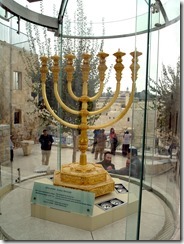
The_Golden_Menorah_replica_in_Jerusalem (1)
The Temple Institute's Menorah
prepared for the Third Temple
on display in Jerusalem.

Exodus 37:17 And he made the candlestick of pure gold: of beaten work made he the candlestick; his shaft, and his branch, his bowls, his knops, and his flowers, were of the same:
18 And six branches going out of the sides thereof; three branches of the candlestick out of the one side thereof, and three branches of the candlestick out of the other side thereof:
19 Three bowls made after the fashion of almonds in one branch, a knop and a flower; and three bowls made like almonds in another branch, a knop and a flower: so throughout the six branches going out of the candlestick.
20 And in the candlestick were four bowls made like almonds, his knops, and his flowers:
21 And a knop under two branches of the same, and a knop under two branches of the same, and a knop under two branches of the same, according to the six branches going out of it.
22 Their knops and their branches were of the same: all of it was one beaten work of pure gold.
23 And he made his seven lamps, and his snuffers, and his snuffdishes, of pure gold.
24 Of a talent of pure gold made he it, and all the vessels thereof.

You will notice that although no specific dimensions are given it was designed to look like an almond bush with branches, buds, flowers, and fruit, and from the tip of each of the seven branches the stem burst forth into light.

Allow me to drag you in haste through the corridors of time forward nearly 1,500 years. About six months before Jesus’ death had come to Jerusalem to attend the Feast of Tabernacles. This harvest feast commemorated the period the Jews spent wandering in the Wilderness. Temporary shacks or booths were erected out of branches for this purpose, and the Jews spent some time living in these booths during the eight days of the feast. As the years progressed, the Jews of Palestine added some other elaborate events, such as the ritual drawing of the water from the Pool of Siloam as a memorial of the water that flowed from the Rock in Horeb. It was during that ceremony that Jesus stood and shouted through the solemn hush, If any man thirst, let him come unto me and drink. (John 7.37)

All through the Feast there had been a vigorous national discussion over the place of Jesus. He had been fussed at from all sides, and that was even before He ruined the closing ceremonies with His dramatic announcement. After that bold declaration the Sanhedrin met, reprimanded the Temple police for failing to stop Him, and then argued themselves horse over Who He was and what He represented.

The next day, an unbowed Jesus Christ marches right back into the Temple, and proceeds to spend the entire day teaching. This Temple was not the one built by Solomon, of course, for that one had burned six centuries before. At its heart it was Ezra’s Temple built during the Return but now ‘twas hardly recognizable as such. Herod the Great, now long dead, had launched a massive renovation of it that at this point had been going on for nigh on four decades.

Included in this project were vast courtyards where tens of thousands of Jews could gather. How to light these courtyards at night? Why not use that world-wide symbol of Judaism, the menorah? There was one inside the Holy Place but there was another, even larger one, gracing the exact courtyard where Jesus tangled with the Pharisees that night. Twice as tall as an interstate street light, its ornate branches fairly burst forth with brilliance, lighting up the Treasury in the Court of the Women hundreds of feet in every direction.

The world's tallest menorah, sixty-two feet high
Manado, Indonesia
Picture the scene in all of its grandeur. Tens of thousands of Jews are gathered, debating, discussing, enjoying the Temple grounds following the Feast of Tabernacles. Evening has fallen. Herod’s great menorah, so huge its likeness can still be seen on the Arch of Titus in Rome, lofted fire seventy five feet into the air in all directions. The Sanhedrin and the Pharisees have been after Him all week. Yesterday, He ruined the parade coming from the Pool of Siloam and stole the High Priest’s thunder. Today, He teaches all day and brings such conviction to the Pharisees simply by writing on the ground that they are still running. Tonight, then, what will He do tonight?

Standing in the blaze of glory He shouts, I am the light of the world: he that followeth me shall not walk in darkness, but shall have the light of life. (John 8.12)

It is not difficult at all to see what the Menorah in Moses’ Tabernacle represented about the Messiah. He told us Himself a millennia and a half later. To this both the Apostle John and John the Baptist agreed, saying,

John 1. 4 In him was life; and the life was the light of men.
5 ¶ And the light shineth in darkness; and the darkness comprehended it not.
6 There was a man sent from God, whose name was John.
7 The same came for a witness, to bear witness of the Light, that all men through him might believe.
8 He was not that Light, but was sent to bear witness of that Light.
9 That was the true Light, which lighteth every man that cometh into the world.

What is so interesting here is not just the time and place of Jesus’ stark announcement, but the last phrase of that announcement. I am the light of the world. Jesus did not come just to be the Jewish Messiah, nor even just the Jewish Redeemer. He came for the whole world.

This was referenced all the way back at His birth when Simeon prophesied
he was A light to lighten the Gentiles. (Luke 2.32) That penultimate Jewish prophet, Isaiah, said the same thing, boldly declaring that the Messiah would save not just Jews, but everyone else as well. It is a light thing that thou shouldest be my servant to raise up the tribes of Jacob, and to restore the preserved of Israel: I will also give thee for a light to the Gentiles, that thou mayest be my salvation unto the end of the earth. (Isaiah 49.6)
Not only was this prophesied in the Old Testament and referenced at His birth, it was also understood this way by the Early Church. When Paul sought to explain why he routinely left synagogues and turned to reaching Gentiles in the cities in which he ministered he said, For so hath the Lord commanded us, saying, I have set thee to be a light of the Gentiles, that thou shouldest be for salvation unto the ends of the earth. (Acts 13.47)


Over three thousand years ago Moses instructed Bezaleel and company to make an ornate candlestick in the form of an almond tree. It was then lovingly placed in the Holy Place and carefully tended, filled with oil, the wicks trimmed and burning warmly. Two thousand years ago my Saviour announced that Menorah referred to Himself, and that He came to bring salvation to the entire world. Today, I sit overlooking a quiet hillside down by the Mississippi River, an ocean, a continent, and a world away from the Palestine of Jesus’ day and the Wilderness of Moses’ day. And I am glad. For that light has reached all the way to me.

2217719955_9999032774


The whole world was lost in the darkness of sin,
The light of the world is Jesus!
Like sunshine at noonday, His glory shone in;
The light of the world is Jesus!
-P. P. Bliss







Sunday, October 14, 2018

The Table of Shewbread

The Tabernacle 5

Note: These kinds of studies, types and figures, et al, often find one man slightly disagreeing with another. If you disagree with my conclusions in this series and your disagreement is an educated one I welcome hearing it. Perhaps you may help me. Hopefully, along the way, I will help you too.

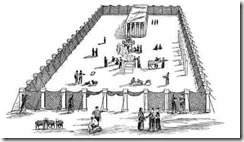
We have discussed the importance of studying the Tabernacle, and we have examined the courtyard and the furnishings in it, the Brazen Altar and the Laver . Today we are going to turn our attention to the structure itself, and what was inside of it.

The Tabernacle proper was composed of just two rooms. The first or front room is generally called the Holy Place and contained three items of furniture. As you walked in on your left was the Candlestick, on your right was the Table of Shewbread, and straight ahead of you was the Altar of Incense. In this post we are going to discuss one of the more confusing (to me, anyway, I puzzled long over this) pieces, the Table of Shewbread.

Timna_Tabernacle_Table_of_ShowbreadThe Table of Shewbread was a two cubits long, one cubit wide, and one and a half cubits high. Along the edge of the table was a border or a raised edge made of gold. This produced a table that was like a very large tray, basically. For mobility, it contained rings in the legs that were threaded through with staves when it was time to move it. I believe the Table of Shewbread represents our union with Christ, that identification with Him which comes to us at our salvation.

Exodus 37. 10 And he made the table of shittim wood: two cubits was the length thereof, and a cubit the breadth thereof, and a cubit and a half the height thereof:
11 And he overlaid it with pure gold, and made thereunto a crown of gold round about.
12 Also he made thereunto a border of an handbreadth round about; and made a crown of gold for the border thereof round about.
13 And he cast for it four rings of gold, and put the rings upon the four corners that were in the four feet thereof.
14 Over against the border were the rings, the places for the staves to bear the table.
15 And he made the staves of shittim wood, and overlaid them with gold, to bear the table.
16 And he made the vessels which were upon the table, his dishes, and his spoons, and his bowls, and his covers to cover withal, of pure gold.

The Scripture tells us that Jesus is the Bread of Life. Then Jesus said unto them, Verily, verily, I say unto you, Moses gave you not that bread from heaven; but my Father giveth you the true bread from heaven. For the bread of God is he which cometh down from heaven, and giveth his life unto the world. (John 6.32-33) But I think it is too simplistic simply to say the Table represents Christ as the Bread of Life, primarily because there were twelve loaves on it. I think that number is significant, and leads us on to a deeper meaning.

Each of these twelve loaves must have been quite large for each loaf used twelve cups of flour. (Leviticus 24.5) Compare that with a regular loaf of bread that uses a bit more than three or so. They were placed on the Table hot on the Sabbath day while the stale ones, having sat there for a week, were taken away.

The twelve loaves on the Table were there as physical representations of the twelve tribes of Israel. I draw this from other similar uses in the Word of God. For example, when Joshua led the children of Israel across the Jordan River he built an altar in the middle of it as a memorial of that crossing. Each tribe brought a stone thus creating an altar of twelve stones, each stone representing a tribe.

Paul tells us in the New Testament that there is a connection between the Church and Israel, namely that the Church participates in the spiritual promises given to God’s Old Testament people.


Galatians 3. 6 Even as Abraham believed God, and it was accounted to him for righteousness.
7 Know ye therefore that they which are of faith, the same are the children of Abraham.
8 And the scripture, foreseeing that God would justify the heathen through faith, preached before the gospel unto Abraham, saying, In thee shall all nations be blessed.
9 So then they which be of faith are blessed with faithful Abraham.

As children of God by faith we are placed in Christ. This union with Him is mentioned often and variously described in Scripture. We are crucified with Christ. (Galatians 2.20) We are buried with him. (Romans 6.4) We are risen with Christ. (Colossians 3.1) We are in Christ Jesus. (Ephesians 2.6)

The best way I know to describe the meaning of the phrase “in Christ” is that what happened or happens to Him happens to me. For example, if eat an apple and then walk to the store the apple goes to the store too. Why? Because it is in me. If I place a bookmark into a book and then drop the book into the lake the bookmark goes into the lake too. Why? Because it is in the book.

You and I are in Christ. We are placed in Him, and what happens to Him happens to me. There is a union there, a joining there. Indeed, Paul goes so far as to use the word “communion” in this sense in I Corinthians 10.16-17 in reference to the New Testament table, the Lord’s Supper. The cup of blessing which we bless, is it not the communion of the blood of Christ. The bread which we break, is it not the communion of the body of Christ? For we being many are one bread, and one body: for we are all partakers of that one bread.

Jesus Christ is the Bread of Life. We are in Christ. Just as those twelve loaves represented the twelve tribes and their connection to the Bread of Life so in our dispensation they reveal our connection with Him, our union with Him, our communion with Him.

4268d-6060316_4066480_lz-1There is security here, of the eternal kind. I cannot become unsaved again. My life is hid with Christ in God. There is blessing here, numerous and rich. Who hath blessed us with all spiritual blessings in heavenly places in Christ. (Ephesians 1.3) The Father has given everything to the Son, and since I am in Him I share in all of that. (Romans 8.16-17) There is peace and unity with other’s of God’s children here. Since I am in Christ and you are in Christ we are close to each other. (Ephesians 2.11-19, Galatians 3.26-28) I could go on and on and on.

I do not deserve to be on that Old Testament Table, pure, presented to Jehovah. I do not deserve to partake of that New Testament table, pure, celebrating my (comm)union with Christ, the Bread of Life. But I am and I do. And I sure am glad.


Sunday, October 7, 2018

The Laver

The Tabernacle 4

Note: These kinds of studies, types and figures, et al, often find one man slightly disagreeing with another. If you disagree with my conclusions in this series and your disagreement is an educated one I welcome hearing it. Perhaps you may help me. Hopefully, along the way, I will help you too.

Exodus 40:30–32
30 And he set the laver between the tent of the congregation and the altar, and put water there, to wash withal.
31 And Moses and Aaron and his sons washed their hands and their feet thereat:
32 When they went into the tent of the congregation, and when they came near unto the altar, they washed; as the LORD commanded Moses.


bronze-laver-priestOffering sacrifices is a bloody business. Practically speaking, having a source of water near at hand helps tremendously in cleaning up. As the old saying goes, cleanliness is next to godliness, and that was never more true than it was for the Jewish people. Leviticus, the priestly manual of operations, emphasizes the necessity of moral and physical and ceremonial cleanliness constantly. This emphasis found a ready heart in the Jewish religion of the Old Testament, and in this culture a laver – a wash basin set on a pedestal – makes perfect sense. What was it for? The answer is simple: cleanliness.

There is here, however, more than meets the eye, for the Laver was used by the priests two ways. First, it was used by them on their commissioning to wash themselves in entirety. (Exodus 40.11-16) Second, it was used by them on a daily basis to wash their hands and feet only. (Exodus 30.19-20)

I find clear parallels to these two uses in the New Testament. First, we are to be washed entire, cleansed of our sin, upon salvation. Paul calls this in Titus 3.5 the washing of regeneration and in Corinthians 6.11 says the same: And such were some of you: but ye are washed, but ye are sanctified, but ye are justified in the name of the Lord Jesus, and by the Spirit of God. Both of these clearly liken salvation to be cleansed wholly via water.
There is also, however, a second illustration repeated in the New Testament in relation to washing. In this case it was not for the entire body, but only for the feet. The practical reason for foot washing was that the dusty roads of Palestine combined with the open-toed sandals of the day made for a grimy result. But that regular custom of hospitality was clearly used by our Saviour in a spiritual way at the Last Supper.

460px-Jacopo_Tintoretto_-_Christ_washing_the_Feet_of_the_Disciples_-_Google_Art_Project
Christ Washing the Disciples Feet by Tintorreto
c 1580
John 13:4–10
4 He riseth from supper, and laid aside his garments; and took a towel, and girded himself.
5 After that he poureth water into a bason, and began to wash the disciples’ feet, and to wipe them with the towel wherewith he was girded.
6 Then cometh he to Simon Peter: and Peter saith unto him, Lord, dost thou wash my feet?
7 Jesus answered and said unto him, What I do thou knowest not now; but thou shalt know hereafter.
8 Peter saith unto him, Thou shalt never wash my feet. Jesus answered him, If I wash thee not, thou hast no part with me.
9 Simon Peter saith unto him, Lord, not my feet only, but also my hands and my head.
10 Jesus saith to him, He that is washed needeth not save to wash his feet, but is clean every whit: and ye are clean, but not all.

Jesus is not using this as an illustration of salvation. The Apostles were already washed in that sense – he that is washed – but yet they still needed some additional, or I should say, regular cleansing – needeth not save to wash his feet. Spiritually speaking, their feet got dirty and needed cleansed.

The Psalmist uses a curious turn of phrase in Psalm 49.5, the iniquity of my heels. What is the iniquity of my heels? I am saved, cleansed entirely of my sin by the washing of regeneration. I am thus justified. But as I journey through life (as I walk the dusty roads of Palestine in the process of living my daily life) I inevitably find myself with some sin or other clinging to me. If I let it continue unchecked I will be the like the boy who grew turnips in his ears because he refused to take a bath. I will be miserably unhappy. I will be out of fellowship with God’s people. God will not hear my prayers. I will be living apart from Him rather than abiding in Him. I must needs take a spiritual bath every time I sin. Why? To cleanse the iniquity of my heels, to restore fellowship, to grow deeper into my intimacy with Christ. Without this I, like Peter, have no part with Him.

John said it this way in the epistle he wrote about sixty years after Jesus washed his feet at the Last Supper: If we confess our sins, he is faithful and just to forgive us our sins, and to cleanse us from all unrighteousness. (I John 1.9) From time to time in my Christian journey I have met those who insist that this passage does not teach anything like regular confession of daily sin. They assert that instead it represents salvation and that is all. They could not be more mistaken. Why? Simply put, because the epistle of I John is plainly directed toward those who are already Christians.

John addresses his readers as my little children. (2.1) He calls them brethren. (2.7) He tells us he is writing to those who already know the truth. (2.21) John tells them to continue in the Son. (2.24) He explicitly says his readers are already now the sons of God. (3.2) He says his readers already love God. (4.19) He says that God hath given to us eternal life. (5.11) He closes with the assumption that we are in him that is true. (5.20) There can be no doubt whatsoever. The epistle of I John is not directed toward the unsaved in an effort to get them saved; it is directed toward those who are already the children of God that their fellowship with God and with each other might be improved.

The danger of rejecting this interpretation and application is two-fold. First, I have hamstrung my prayer life. If I am living in known sin I do not jeopardize my salvation but I do jeopardize my hearing before God. (Psalm 66.18) Second, I have deceived myself and instead of walking in the light I am walking in darkness. If we say that we have no sin, we deceive ourselves, and the truth is not in us. (I John 1.8). If we say that we have not sinned, we make him a liar, and his word is not in us. (I John 1.10) John is talking about the man who is already a Christian. If that man denies the necessity of confession in order to obtain fellowship he is simply deceiving himself.

In this John lines with all kinds of scriptural precept and illustration. In addition to the Laver illustration in the Old Testament and our Saviour at the Last Supper, Paul, in Ephesians, says that a Christian has both a standing and a state before God. In standing he is entirely sanctified; in state he is somewhere in the process of sanctification that comes between being birthed into the new life and being formed fully into the image of Christ. God views me right now as though I were already in Heaven fully possessed of the righteousness of Christ; that is my standing. But my actual state at the moment is not nearly as holy as my standing.

John writes I John so that, amongst other reasons, my actual condition or state in this life progresses in holiness. He writes so that I sin less. My little children, these write I unto you, that ye sin not. And if any man sin, we have an advocate with the Father, Jesus Christ the righteous. (I John 2.1) What tool is necessary to accomplish this? The tool of daily confession of sin, of bowing my heart before His throne and telling God I am sorry for the sin that has accumulated in life.

jesus_washing_feet02God and I cannot partner together if I allow unconfessed sin to pile up in my life. I have already washed, but the iniquity of my heels is the problem. I still need to wash my feet on a regular basis as I serve Him. It is the only way I can have a part with Him.

You long ago used the laver of salvation. Get alone somewhere today and use the laver of confession. Without it, you are not fit to serve Him.


Sunday, September 23, 2018

The Brazen Altar

The Tabernacle 3

Note: These kinds of studies, types and figures, et al, often find one man slightly disagreeing with another. If you disagree with my conclusions in this series and your disagreement is an educated one I welcome hearing it. Perhaps you may help me. Hopefully, along the way, I will help you too.

Exodus 38:1–7 310px-High_Priest_Offering_Sacrifice_of_a_Goat
1 And he made the altar of burnt offering of shittim wood: five cubits was the length thereof, and five cubits the breadth thereof; it was foursquare; and three cubits the height thereof.
2 And he made the horns thereof on the four corners of it; the horns thereof were of the same: and he overlaid it with brass.
3 And he made all the vessels of the altar, the pots, and the shovels, and the basons, and the fleshhooks, and the firepans: all the vessels thereof made he of brass.
4 And he made for the altar a brasen grate of network under the compass thereof beneath unto the midst of it.
5 And he cast four rings for the four ends of the grate of brass, to be places for the staves.
6 And he made the staves of shittim wood, and overlaid them with brass.
7 And he put the staves into the rings on the sides of the altar, to bear it withal; he made the altar hollow with boards.

You have sinned. You took a blood oath, a covenant oath, to observe to do all that Moses said God commanded, but you failed. You wanted to obey. You tried. You love and fear Jehovah, and in gratitude to Him for rescuing you and your family from Egypt you want more than anything to please Him. But still you failed. You violated His commandments. And you feel rotten about it.

Stepping out of your tent into the rising sun of dawn you hope this day will be different, that you will get your act together and keep it together. But doubt gnaws at you. In your heart of hearts you know that today you will sin too. It seems unstoppable, no matter your good intentions and best efforts. Disconsolately, you kick the sand. You wander aimlessly around the encampment. Should you talk to an elder? Should you buck up and soldier on? Should you forget it all, stop worrying about it? Impossible. It eats at Whale_Shark_in_Shallow_Wateryou, this sin of yours, shredding your piece of mind like you feared those sharks you saw in the walls of water around you would shred you as you walked the floor of the Red Sea.

What’s that? Someone is calling your name? Looking up you see the Doorkeeper. Standing in front of the ornate curtained entrance to the Tabernacle he is asking you if you would like to come inside, make an offering perhaps. Should you? Dare you? Won’t Moses find out? Won’t Aaron be angry with you? Won’t the priests on duty take one look at you and turn away in disgust?

You stop. Pause is a better word, debating whether this is a tragic mistake or a good idea. Undecided, you feel the warmness in the Doorkeeper’s invitation seep around the edges of your cold fear. Turning, you take a step toward the entrance. But will it do any good? Will this change anything?

This is it. You have reached the entrance. What will you do? Screwing your courage to the sticking point you step over the thresh hold. Into salvation, redemption, and righteousness. And right before you eyes you see it, the Brazen Altar. Five cubits square and three high, how 350px-Book_of_Exodus_Chapter_28-2_(Bible_Illustrations_by_Sweet_Media)could you possibly miss it? Gleaming a soft bronze color in the early light, smoke still curling up from the morning sacrifice held in place by the horned corners, it draws you like a lodestone.

As a Jew, you know your history. It has been drilled into you on the green banks of the Nile. Father Abraham walking Isaac up to Mount Moriah only to find Jehovah replacing his son with a ram. Jacob at Bethel. Pondering, you recalled what you had recently heard Moses say. Behold, all souls are mine; as the soul of the father, so also the soul of the son is mine: the soul that sinneth it shall die. The soul that sinneth it shall die. The son shall not bear the iniquity of the father, neither shall the father bear the iniquity of the son: the righteousness of the righteous shall be upon him, and the wickedness of the wicked shall be upon him. (Exodus 18.4, 20) Where there is sin there must be death, and nothing said “death” like the enormous altar in front of you.

…and that, to my understanding, was exactly the point of the Brazen Altar. Gory, burning, stinging the eyes with its smoke, it screamed the death that was necessary to cover sin. If the whole idea of a sacrifice was to cause God to overlook a person’s sin then that sacrifice had to involve death. This is seen not only in the Jews earliest history, but in humanity’s history, which the Jews were obviously familiar with. Adam and Eve sinned. To cover them with skins required death.

The Jewish religion was such a bloody religion precisely because it was designed to point to this aspect of their future Messiah – His death. It was absolutely critical that they understand this so God gave them a process that declared it to them again and again and again. And almost all things are by the law purged with blood; and without shedding of blood is no remission. (Hebrews 9.22)

Ask me what is the saddest thing about the Jewish people and I will tell you this: in spite of their zeal and knowledge in the things of Jehovah they have totally missed the point of their own Messiah. As a result, they rebelliously refused to accept Him when He arrived. They wanted an earthly deliverer, someone who would subdue Rome and raise them to the pinnacle of the world. Their Messiah wanted to deliver them from their sins, and raise them to the pinnacle of Heaven. But under no condition should they have missed this. Jesus said exactly this to Nicodemus, Art thou a master of Israel, and knowest not these things? (John 3.10)

In addition to the impossible-to-miss illustration of the Brazen Altar, the necessary death of the Messiah for the people’s sins was explicitly stated by the greatest preacher of the Old Testament.

Isaiah 53:1–9
1 Who hath believed our report? And to whom is the arm of the LORD revealed?
2 For he shall grow up before him as a tender plant, And as a root out of a dry ground: He hath no form nor comeliness; And when we shall see him, there is no beauty that we should desire him.
3 He is despised and rejected of men; A man of sorrows, and acquainted with grief: And we hid as it were our faces from him; He was despised, and we esteemed him not.
4 Surely he hath borne our griefs, And carried our sorrows: Yet we did esteem him stricken, Smitten of God, and afflicted.
5 But he was wounded for our transgressions, He was bruised for our iniquities: The chastisement of our peace was upon him; And with his stripes we are healed.
6 All we like sheep have gone astray; We have turned every one to his own way; And the LORD hath laid on him the iniquity of us all.
7 He was oppressed, and he was afflicted, Yet he opened not his mouth: He is brought as a lamb to the slaughter, And as a sheep before her shearers is dumb, So he openeth not his mouth.
8 He was taken from prison and from judgment: And who shall declare his generation? For he was cut off out of the land of the living: For the transgression of my people was he stricken.
9 And he made his grave with the wicked, And with the rich in his death; Because he had done no violence, Neither was any deceit in his mouth.

2018-05-31 14.38.30This is why it is good for us to keep the cross front and center in our Christianity. That sacrificial death was absolutely necessary, for them and for us. No wonder the Tabernacle was structured in such a way as to remind the Jews of that – every single day.

Where there is sin there must be death. Mine or His. The Brazen Altar proves it.


Sunday, September 16, 2018

The Courtyard

The Tabernacle 2

Note: These kinds of studies, types and figures, et al, often find one man slightly disagreeing with another. If you disagree with my conclusions in this series and your disagreement is an educated one I welcome hearing it. Perhaps you may help me. Hopefully, along the way, I will help you too.
_______________________________________________________________________

Any study of the Tabernacle will, almost by default, involve an examination of much Scripture. After all, we are attempting to discover what different aspects of it referenced regarding the work of Christ and we do not want to do that with opinion. Of necessity, then, this short blog series will involve more scripture selections than I normally use in writing. I cannot bring myself to apologize for it and I am sure you would not desire me to do so.
CourtLet us begin with the instructions Moses received regarding the exterior of the Tabernacle. I have chosen to call this the courtyard.

Exodus 27:9–18
9 And thou shalt make the court of the tabernacle: for the south side southward there shall be hangings for the court of fine twined linen of an hundred cubits long for one side:
10 And the twenty pillars thereof and their twenty sockets shall be of brass; the hooks of the pillars and their fillets shall be of silver.
11 And likewise for the north side in length there shall be hangings of an hundred cubits long, and his twenty pillars and their twenty sockets of brass; the hooks of the pillars and their fillets of silver.
12 And for the breadth of the court on the west side shall be hangings of fifty cubits: their pillars ten, and their sockets ten.
13 And the breadth of the court on the east side eastward shall be fifty cubits.
14 The hangings of one side of the gate shall be fifteen cubits: their pillars three, and their sockets three.
15 And on the other side shall be hangings fifteen cubits: their pillars three, and their sockets three.
16 And for the gate of the court shall be an hanging of twenty cubits, of blue, and purple, and scarlet, and fine twined linen, wrought with needlework: and their pillars shall be four, and their sockets four.
17 All the pillars round about the court shall be filleted with silver; their hooks shall be of silver, and their sockets of brass.
18 The length of the court shall be an hundred cubits, and the breadth fifty every where, and the height five cubits of fine twined linen, and their sockets of brass.

I believe the entrance itself was designed by Jehovah to represent the salvation that is in Christ. Jesus would later assert, I am the door: by me if any man enter in, he shall be saved, and shall go in and out, and find pasture. (John 10.9) The gate faced east so that those who entered for the morning sacrifice did so in the light. The gate was the only way of access; there was no other way in at all. Thus, the gate was designed for everybody – rich, poor, priest, Levite, Jew, proselyte – all had to come in the same way. Included in this “whosever” gate especially were those who were sinners. They did not have to clean up first. They came through that gate in order to be cleansed. And it only took one step to get inside. It was not a process; it was instantaneous.

Let us turn our attention now to the linen material that formed the fence around the courtyard. The length of the court shall be an hundred cubits, and the breadth fifty every where, and the height five cubits of fine twined linen, and their sockets of brass. (Exodus 27.18) This purified white linen, marred by no imperfection or flaw or stain, represented the righteousness that is to be found in Christ. At His transfiguration we are told, And his raiment became shining, exceeding white as snow; so as no fuller on earth can white them. (Mark 9.3) That moment of glory pulled back the curtain of Jesus’ flesh and revealed to those around His essential moral purity, His absolute holiness. This is in direct contrast to the Biblical illustration of filthy garments as representative of sin. But we all as an unclean thing, and all our righteousness are as filthy rags; and we all do fade as a leaf; and our iniquities, like the wind, have taken us away. (Isaiah 64.6) To the contrary, when the wind blew Tabernacle-model-and-courtyard,-tb030807082-bibleplacesaround the Tabernacle those billowing walls of pure white were securely anchored in place. Step inside the gate – salvation – and you immediately find yourself surrounded by the white linen of righteousness.

We find this illustration from one end of Scripture to the other, but especially in Revelation.

3.4 Thou hast a few names even in Sardis which have not defiled their garments; and they shall walk with me in white: for they are worthy.
5 He that overcometh, the same shall be clothed in white raiment; and I will not blot out his name out of the book of life, but I will confess his name before my Father, and before his angels.
…
6.9 And when he had opened the fifth seal, I saw under the altar the souls of them that were slain for the word of God, and for the testimony which they held:
10 And they cried with a loud voice, saying, How long, O Lord, holy and true, dost thou not judge and avenge our blood on them that dwell on the earth?
11 And white robes were given unto every one of them; and it was said unto them, that they should rest yet for a little season, until their fellowservants also and their brethren, that should be killed as they were, should be fulfilled.
…
7.13 And one of the elders answered, saying unto me, What are these which are arrayed in white robes? and whence came they?
14 And I said unto him, Sir, thou knowest. And he said to me, These are they which came out of great tribulation, and have washed their robes, and made them white in the blood of the Lamb.
…
19.8 And to her was granted that she should be arrayed in fine linen, clean and white: for the fine linen is the righteousness of saints.
…
19.14 And the armies which were in heaven followed him upon white horses, clothed in fine linen, white and clean.

Without a doubt, these linen walls represented righteousness, and the only way into that righteousness was via salvation. Once we come to Christ to solve our sin problem we will find ourselves completely enclosed in the perfect righteousness of that Saviour. What precious thoughts!

In addition to the gate and the linen fence we see a third metaphor of Christ in the courtyard, namely the purified silver metal that gleamed here and there in between the linen. Anchored to wooden supports, it supported those linen walls. I believe this silver represents the redemption from sin that Christ would bring.

Exodus 36:24–26
24 And forty sockets of silver he made under the twenty boards; two sockets under one board for his two tenons, and two sockets under another board for his two tenons.
25 And for the other side of the tabernacle, which is toward the north corner, he made twenty boards,
26 And their forty sockets of silver; two sockets under one board, and two sockets under another board.

I do not want to press this illustration too hard, but the context of what silver was used for in Moses’ day is interesting. A massive slave horde exited Egypt in a tremendous hurry on the day after Passover, and they had experienced precious little peace and quiet since. The pause at Mt. Sinai was not just for religious reasons; it was also for organizational reasons. A society, albeit a mobile one, needed to be standardized out of the chaos of the exodus. To that end, God instructed Moses to count and tax each adult male. This tax was to be paid at the Tabernacle and was called “atonement money”. Every adult male paid the exact same amount, a half shekel.


smallExodus 30:11–16
11 And the LORD spake unto Moses, saying,
12 When thou takest the sum of the children of Israel after their number, then shall they give every man a ransom for his soul unto the LORD, when thou numberest them; that there be no plague among them, when thou numberest them.
13 This they shall give, every one that passeth among them that are numbered, half a shekel after the shekel of the sanctuary: (a shekel is twenty gerahs:) an half shekel shall be the offering of the LORD.
14 Every one that passeth among them that are numbered, from twenty years old and above, shall give an offering unto the LORD.
15 The rich shall not give more, and the poor shall not give less than half a shekel, when they give an offering unto the LORD, to make an atonement for your souls.
16 And thou shalt take the atonement money of the children of Israel, and shalt appoint it for the service of the tabernacle of the congregation; that it may be a memorial unto the children of Israel before the LORD, to make an atonement for your souls.

Much more would be said by Moses soon regarding this thing of atonement, but for the moment let us note that it was paid to the Tabernacle, and paid in silver. And it was these same silver half-shekels that were melted down and used to form the socket supports for the boards that held up the linen walls of the Tabernacle courtyard.

Exodus 38:25–27 (KJV 1900)
25 And the silver of them that were numbered of the congregation was an hundred talents, and a thousand seven hundred and threescore and fifteen shekels, after the shekel of the sanctuary:
26 A bekah for every man, that is, half a shekel, after the shekel of the sanctuary, for every one that went to be numbered, from twenty years old and upward, for six hundred thousand and three thousand and five hundred and fifty men.
27 And of the hundred talents of silver were cast the sockets of the sanctuary, and the sockets of the vail; an hundred sockets of the hundred talents, a talent for a socket.

This head tax, for lack of a better phrase, continued to be required on an on-going basis as the family’s oldest boy reached his maturity. Initially, Jehovah required the service of the eldest son in each family and when He later shifted that service requirement to the Levites as a class the oldest son in each family in Israel was required to pay this tax as a sign he was opted out of service. Later, we find it labeled “redemption money.”

Numbers 3:46–51
46 And for those that are to be redeemed of the two hundred and threescore and thirteen of the firstborn of the children of Israel, which are more than the Levites;
47 Thou shalt even take five shekels apiece by the poll, after the shekel of the sanctuary shalt thou take them: (the shekel is twenty gerahs:)
48 And thou shalt give the money, wherewith the odd number of them is to be redeemed, unto Aaron and to his sons.
49 And Moses took the redemption money of them that were over and above them that were redeemed by the Levites:
50 Of the firstborn of the children of Israel took he the money; a thousand three hundred and threescore and five shekels, after the shekel of the sanctuary:
51 And Moses gave the money of them that were redeemed unto Aaron and to his sons, according to the word of the LORD, as the LORD commanded Moses.

In such a context it is not hard to understand why I have redeemedlabeled silver as a symbol of our purchased redemption. There was no exception to this price. This was the only price. Nothing different was accepted. Nothing beyond this was needed. 

In summary, as you step into the Tabernacle courtyard you come through the gate, which represents the salvation that is only available in Christ. You are then enveloped in the beautifully white linen of righteousness, Christ’s righteousness not your own. This righteousness was based on or supported by the silver sockets of your redemption through Christ’s death, a death that atoned for your sin. Now if that is not a pretty picture of Jesus Christ and what He does for the transgressor I do not know what is.


What is our part? To receive it, and to urge people to enter into it. The psalmist said, For a day in thy courts is better than a thousand. I had rather be a doorkeeper in the house of my God, than to dwell in the tents of wickedness. (Psalm 84.10) As I understand it, the doorkeeper was not there primarily to keep the undeserving out. After all, every one who entered was undeserving. No, I believe the doorkeeper was there at the gate to urge people to come in, to welcome them to take that step, to cross the threshold of salvation and enter into the spotless righteousness obtained by redemption’s price. What a grand thing to be a doorkeeper!

…and this is just the fence that creates the courtyard around the structure.


Sunday, September 9, 2018

Why We Should Study the Tabernacle

The Tabernacle 1

Three thousand four hundred years ago the Jews built a tent Stiftshuette_Modell_Timnapark (1)in the middle of nowhere, anchoring it into the dry blowing sand that is the Sinai Peninsula. That tent, known in Scripture as the Tabernacle, was the center of their worship of God. I am not a Jew. I do not follow the Old Testament system of worship. Hebrews clearly and repeatedly tells us that what we have as the Church is better. So why should I care about the Tabernacle?

First of all, I should pay attention to the Tabernacle in order to help me to better understand the stories that take place in the Old Testament. As the Temple would be later, the Tabernacle was what everything else revolved around for the devout Jew of the day. It was of primary importance in the biblical stories that take place between Exodus and Deuteronomy and figures prominently in many books of the Bible after that. If I want to learn from those Old Testament stories I must understand them, and if I am to understand them well I must grasp the day and time in which they lived. It is easier to enter into their lives, to view them as real people if I have immersed myself in their world. If I do that, it is easier to understand their choices, good or bad, and it is easier to understand what those choices represented. It is easier to understand just how and why exactly God responded to those choices the way He did. In short, paying attention to the Tabernacle will help me to learn more from those Exodus era stories.

Second, I should pay attention to the Tabernacle so that I may better understand salvation, not just in the Old Testament, but also in the New Testament.

The writer of Hebrews tells me that the Tabernacle was a picture, a living three-dimensional image, of the Temple in Heaven, and that its worship was an earthly representation of heavenly truth.

Hebrews 8:1–5
1 Now of the things which we have spoken this is the sum: We have such an high priest, who is set on the right hand of the throne of the Majesty in the heavens;
2 A minister of the sanctuary, and of the true tabernacle, which the Lord pitched, and not man.
3 For every high priest is ordained to offer gifts and sacrifices: wherefore it is of necessity that this man have somewhat also to offer.
4 For if he were on earth, he should not be a priest, seeing that there are priests that offer gifts according to the law:
5 Who serve unto the example and shadow of heavenly things, as Moses was admonished of God when he was about to make the tabernacle: for, See, saith he, that thou make all things according to the pattern shewed to thee in the mount.

thThe New Testament is birthed out of the Old Testament. As Christians, birthed in the New Testament, we must realize that we have Old Testament DNA in our genetic code. Specifically, the Tabernacle is referenced more than 300 times in the Bible, and in the New Testament is used again and again to illustrate some aspect of salvation. If you do not have a decently studied understanding of the Tabernacle most of these illustrations and understandings and their corresponding appreciation will be lost on you. As has been long said, in the Old Testament the New lies hid, and in the New Testament the Old lies open.

Third, I should pay attention to the Tabernacle because there is truth there. Paul tells us that all Scripture is… profitable. (II Timothy 3.16) Surely, that includes the many chapters that discuss the Tabernacle in exquisite detail. More to the point, he pointedly told the Church age that they needed to pay attention to the Old Testament and what it contained. For whatsoever things were written aforetime were written for our learning, that we through patience and comfort of the scriptures might have hope. (Romans 15.4)

The Bible is the revelation of God to man. In other words, every part of the Word of God tells me something about God and about God’s expectations of me. For me to skip major parts of it because I think it is old, or I think it no longer applies in our day is shortsighted and unscriptural. No, I do not build my doctrinal concept of the Church out of the Old Testament because the Church is a New Testament institution. But I do take the Old Testament to be just as much the inspired, preserved Word of God as I do the New Testament. And even the finer points of that Old Testament revelation are worthy of examination for they reveal God to me.

Last, and most importantly, I should pay attention to the Tabernacle because I love Jesus, and I want to know everything about Him that I can.

In the nineteenth century the British navy civilized the globe. In Arthur Herman’s 1975 work, “To Rule the Waves: How 971931the British Navy Shaped the Modern World”, he discusses at some length the technology that went into making that Royal Navy function. Who knew that they seasoned pine trees underwater in Scotland for years before turning them into masts? In the process of discussing this he discussed rope. The Royal Navy used miles and miles of it, an almost endless amount being necessary to properly rig everything from a schooner to a three-decked ship of the line during the era of sail power. Rope was also necessary for England’s vast merchant marine, and furthermore, was relatively easy to steal. How to tell if the rope sitting on some barque sailing to the Azores with tea had been lifted from the Royal Navy’s dockyard? Cut it. Anywhere. Why? Because the navy’s rope had a scarlet thread bound through it, every inch on every ship, for precisely that purpose. A rope with a scarlet thread in it belonged to the Royal Navy, period.

In the Scripture there is a scarlet thread of redemption woven from one end to the other. Open the Bible anywhere, cut into it at any place, yea even the Old Testament, and you will almost immediately see Jesus. In Genesis, He is the seed of the woman. In Exodus, He is the Passover lamb. In Leviticus, He is the high priest. In Numbers, He is the pillar of cloud by day and the pillar of fire by night. In Deuteronomy, He is the prophet like unto Moses. In Joshua, He is the captain of our salvation. In Ruth, he is the kinsman redeemer. In Job, He is the daysman. In Psalms, He is our shepherd. In Proverbs and Ecclesiastes, He is our wisdom. In Isaiah, He is the prince of peace. In Jeremiah, He is the righteous branch. In Daniel, He is the fourth man in the fiery furnace. In Hosea, He is the faithful husband. In Malachi, He is the sun of righteousness risen with healing on his wings. And I could go on and on and on.

It is my settled belief, and one I hope you share with me by the time this short blog series is done, that one of the primary reasons for the Tabernacle and the reason it was structured with such explicit direction was to point Israel to her Messiah, Jesus. We will see Jesus all through the Tabernacle. We will see Him in its structure, in its furniture, and in its materials. We will see how each of these represent some wonderful aspect of what Israel’s then coming Redeemer would be and do.

image_8Boiled down to its simplicity, we pay attention to the Tabernacle in order to know Jesus better. And He is beautiful. Which makes the Tabernacle beautiful. So join me for the next few weeks, and together let us take a stroll through that ancient, dusty tent erected for the first time in the middle of the wastes of the Sinai wilderness. It is a beautiful thing.